


Organic Search vs Paid Search: SEO or Ads?
Introduction
Every business that wants to be found on Google faces the same question: build your way up through SEO, or pay for visibility with ads? The answer isn't as obvious as it sounds — and anyone who tells you one channel always beats the other is oversimplifying.
Organic search vs paid search isn't a competition. It's a strategic choice that depends on your timeline, budget, competitive landscape, and what "results" actually means for your business right now. Organic search drives 53% of all website traffic, while paid sits at around 15% — but those numbers don't tell you which one is right for you. What they do tell you is that both channels matter, and ignoring either one completely is rarely the smart move. This guide breaks down how each works, where each wins, and how to combine them when the time is right.
What Is Organic Search?
Organic search refers to the results that search engines display based on their algorithmic evaluation, without ranking being influenced by advertising payments. These are the blue links you see below any ads — selected purely for relevance, authority, and content quality.
How organic search works
Google's algorithm uses over 200 ranking factors, but the ones that actually move the needle in 2025 are content quality matched to search intent, backlinks from authoritative domains, Core Web Vitals, and E-E-A-T signals. Semrush found that AI Overviews show around 86% domain and 67% URL overlap with traditional Google search results — meaning the same fundamentals that drove organic rankings before still apply in the AI era.
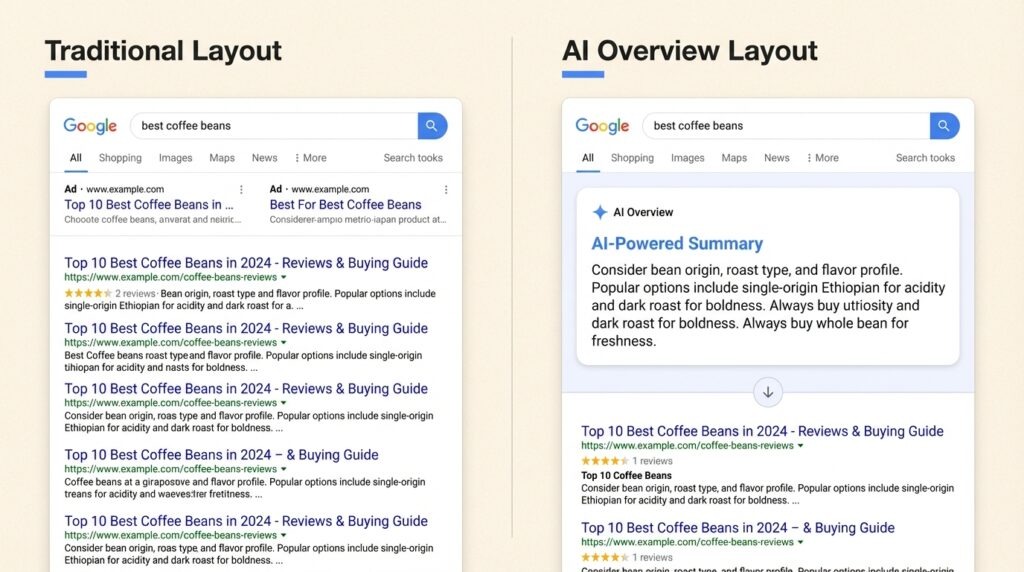
Examples of organic search results
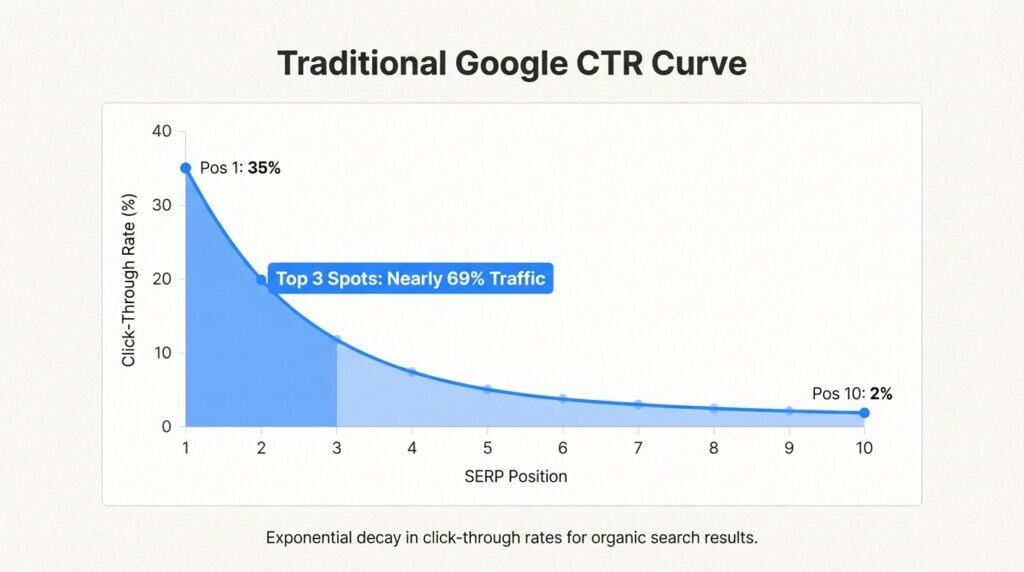
Organic results appear as standard blue links, featured snippets, People Also Ask boxes, image carousels, and local pack listings. The CTR for position 1 in organic search is 39.8%, dropping to 18.7% for position 2 and 10.2% for position 3. Everything beyond page one is largely invisible — only 0.63% of users click on page two results.
The organic search definition in practice means traffic you don't pay per click for — but that doesn't mean it's free. Content creation, technical SEO, and link building all require real investment of time and money.
Typical timelines and expectations
On average, it takes 3–6 months for a site to rank on Google — and that's for less competitive queries. In saturated niches, 12–18 months is realistic before organic traffic becomes a meaningful revenue driver. According to Gartner's 2025 forecast, organic search traffic could decline by 50% by 2028 as AI-powered search alternatives grow — a warning worth factoring into any long-term SEO investment decision.
The organic search benefits that make it worth that wait: compounding returns over time, no per-click costs, and higher trust signals from users who tend to skip ads by default.
What Is Paid Search?
Paid search — or PPC — means paying a search engine to display your ad when someone searches for specific keywords. You bid in an auction, your ad shows up above or below organic results, and you pay when someone clicks. The paid search definition is that simple — but running it profitably is not.
How paid search works
Every time a search query is entered, Google runs a real-time auction among all advertisers targeting that keyword. Your ad position depends on your bid and your Quality Score — a composite of expected CTR, ad relevance, and landing page experience. A higher Quality Score can get you a better position at a lower cost-per-click than a competitor bidding more but with worse ad relevance.
Google Ads placements explained
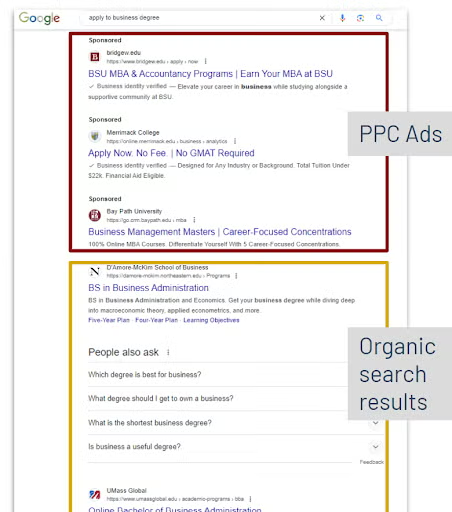
Google Search results organic vs ads are visually similar but labeled differently — paid results carry an "Ad" or "Sponsored" badge and appear above and sometimes below organic listings. Beyond Search, Google Ads also runs on Display Network, YouTube, Gmail, Discover, and Shopping — each with its own auction logic and audience behavior.
The organic listings vs sponsored listings distinction matters for CTR: a 2025 study found that 39.8% of searchers clicked the first organic result, while the CTR of the first paid search result hovers in the low single digits. That gap is why paid search works best for high-intent, commercial queries — not for broad informational searches where users instinctively skip ads.
Payment and auction mechanics
You set a daily budget, choose a bidding strategy (manual CPC, tCPA, tROAS, or Maximize Conversions), and pay per click — not per impression. Smart Bidding uses Google's machine learning to adjust bids in real time based on signals like device, location, time of day, and audience behavior. The paid search benefits are immediate visibility, precise targeting, and full control over budget — the paid search disadvantages are that traffic stops the moment your budget does, and costs in competitive verticals can be punishing.
Organic Search vs Paid Search: Core Differences
The organic vs paid search differences come down to three things: how you pay, how fast you see results, and how much control you have.
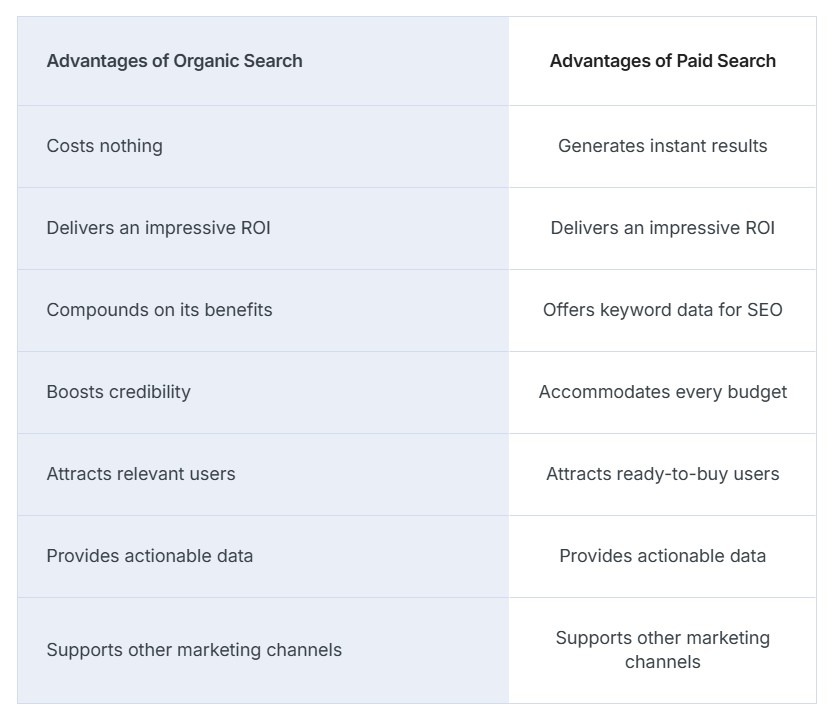
Cost structure
The cost of organic search is front-loaded — content creation, technical SEO, link building. Once rankings kick in, you don't pay per click, and traffic compounds. This leads to 20–50% lower long-term customer acquisition costs compared to paid-only strategies. The cost of paid search is ongoing — the average CPC across Google Ads is $2.69, with an average CPA of $48.96. Stop spending, traffic stops immediately. Think of it as renting visibility versus buying an asset.
Speed of results
This is the clearest distinction in any SEO vs PPC comparison. Paid search delivers clicks the same day a campaign goes live. Organic search takes 3–6 months for meaningful traction in most niches — longer in competitive categories. Long-term SEO vs short-term ads is really a question of patience and cash flow: if you need leads this month, paid wins; if you're building for 2 years out, organic compounds in ways paid never can.
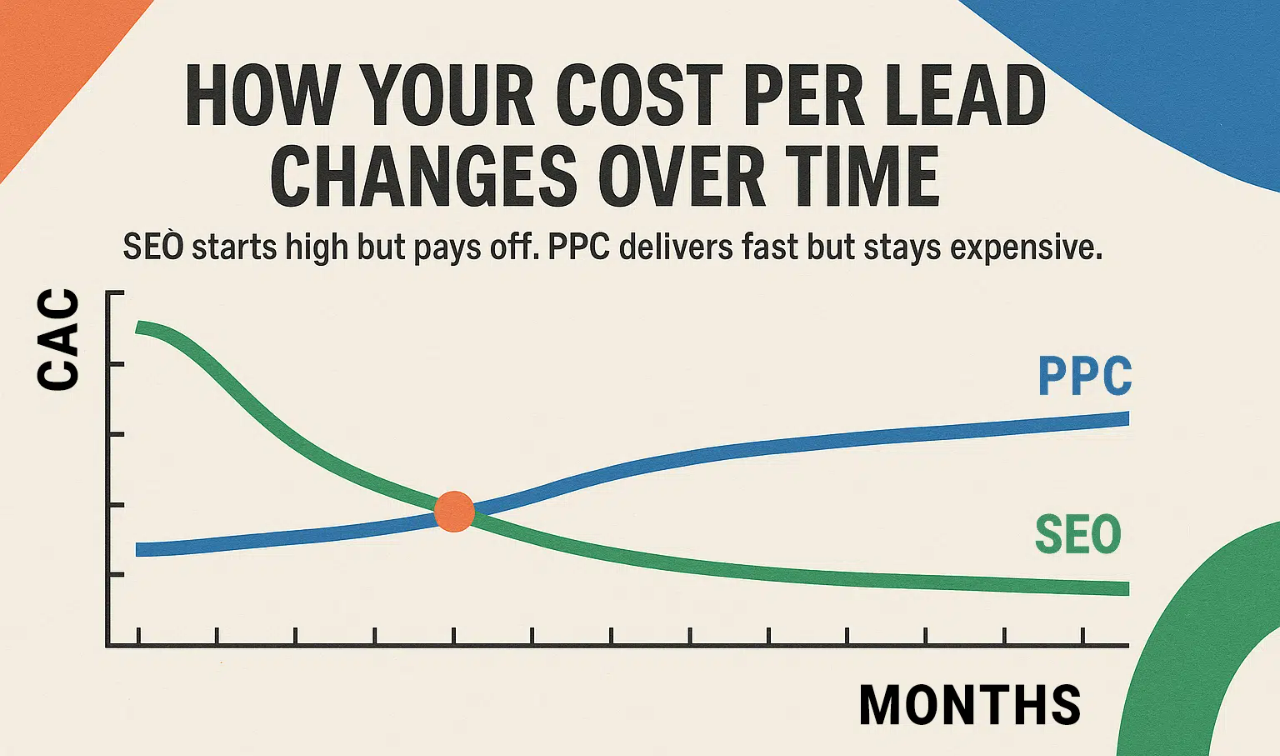
Scalability and control
Paid search scales instantly — double the budget, roughly double the impressions. You control targeting, timing, messaging, and landing pages with precision. Organic search scales slowly but doesn't have a cost ceiling — a single page ranking for hundreds of keywords keeps producing traffic regardless of volume. The search visibility comparison between the two matters in one key way: paid positions are guaranteed as long as you bid; organic positions are earned and can shift with algorithm updates.
Performance Comparison
Traffic quality and intent
94% of all Google clicks go to organic results — only 6% go to paid ads. But that stat needs context. Paid search plays a role in 65% of high-intent commercial searches — meaning when someone is ready to buy, ads perform disproportionately well. Organic traffic vs paid traffic differs in user mindset: organic visitors are often earlier in the research phase, paid visitors are typically closer to a decision.
Conversion potential
The numbers here are more nuanced than most guides admit. Organic search averages a 14.6% conversion rate, while PPC averages around 10%. But consumers who click a paid ad are 50% more likely to purchase than organic visitors — the difference is that paid traffic is pre-qualified by the query and ad targeting before it arrives. Both figures are real; they measure different things.
ROI and lifetime value
49% of marketers report organic search has the best ROI of any marketing channel — but that's a long-term view. Google Ads delivers $2 for every $1 spent, which looks weaker on paper but arrives faster and with more predictability. The search engine marketing comparison that actually helps: organic wins on lifetime value and compounding returns; paid wins on speed, measurability, and control. Neither is better in the abstract — it depends entirely on your timeline and business model.
When to Use Organic Search
Organic search isn't the right answer for every situation — but when it fits, it fits better than anything else. The organic search benefits that matter most: traffic compounds over time, you don't pay per click, and users trust organic results more than ads by default.
Long-term growth scenarios
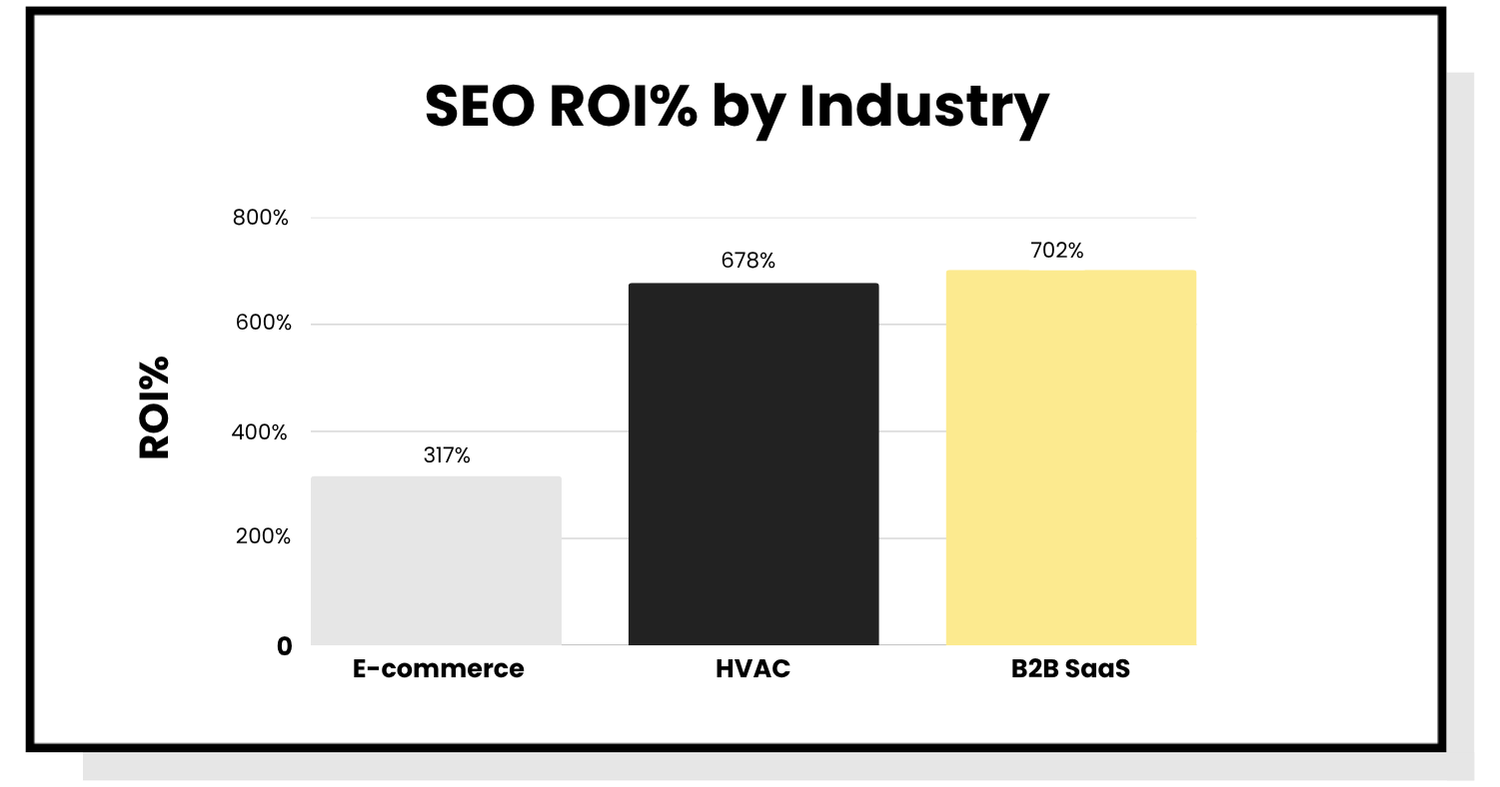
When to use organic search comes down to one question: can you afford to wait? If the answer is yes, the returns are hard to argue with. According to Matt's World SEO research, B2B SaaS companies investing in SEO see an average ROI of 702% with a breakeven point around 7 months. That's not a fast payoff — but it's a durable one. A well-ranked page keeps producing traffic years after it's published, long after any paid campaign would have exhausted its budget.
Canva is the clearest example of organic search done at scale. According to Gravitate's B2B SaaS SEO analysis, Canva generates over 50 million monthly organic visits through template pages — each one targeting a specific use case query. Users arrive already knowing what they want, land directly in the product, and convert without additional friction. That's organic search as a growth engine, not just a traffic channel.
Content-driven industries
Organic search is particularly powerful in content-driven industries where buyers research extensively before purchasing — B2B software, financial services, healthcare, education, and legal. In these categories, the buyer's journey starts with a search query months before any sales conversation happens. Being present in those early-stage searches builds brand familiarity that makes every downstream marketing touchpoint more effective.
Monday.com's SEO strategy illustrates the scale possible with this approach: they produced 1,000 optimized blog posts in 12 months, built with strict content guidelines and targeting a wide range of relevant keywords. The result was a significant jump in organic visibility and qualified traffic — not because of any single piece, but because of systematic coverage of the queries their buyers were actually searching.
Budget-sensitive strategies
For companies that can't sustain high PPC budgets in competitive verticals, organic search is often the only viable long-term channel. The organic search disadvantages — slow ramp-up, algorithm sensitivity, upfront content investment — are real. But for budget-constrained teams, the alternative is paying escalating CPCs indefinitely with nothing to show for it if spend stops.
A B2B SaaS case study by TimeZ Marketing shows what's possible when organic replaces a paid-only model: a mid-market project management platform was spending $180,000 monthly on Google Ads with CPLs exceeding $285. After shifting to a three-phase SEO strategy over 90 days, they scaled monthly pipeline from $180K to $680K while cutting CAC by 86%. SEO-sourced leads converted to demos at 26% versus 14% for PPC, and averaged $18,200 ACV versus $12,500.
When to Use Paid Search
Paid search solves problems that organic can't — speed, precision, and the ability to show up in competitive spaces before you've earned the right to rank there organically.
Competitive niches
In high-CPC verticals — legal, finance, insurance, healthcare — organic ranking takes years and requires enormous authority. According to Hustle Marketers' industry analysis, some legal PPC keywords cost hundreds of dollars per click, yet remain worthwhile because of the high lifetime value of a single acquired client. Law firms, insurance brokers, and financial advisors routinely run paid search not because organic doesn't work, but because the immediate capture of high-intent buyers justifies the cost.
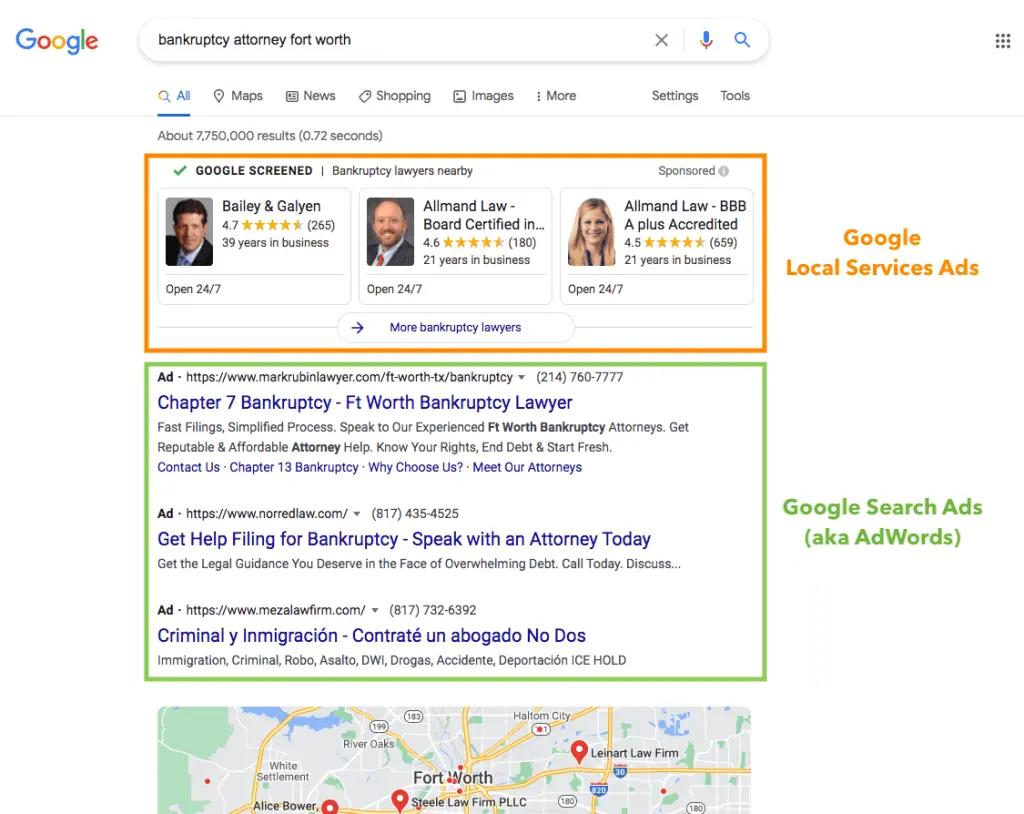
In these niches, paid search benefits are clearest: you appear at position one the day your campaign launches, regardless of domain authority or content history. The paid search disadvantages are equally clear — the moment budgets stop, so does visibility.
Time-sensitive campaigns
Product launches, seasonal promotions, limited-time offers — anything with a hard deadline belongs in paid search, not SEO. When to use paid search for time-sensitive campaigns: set up a Search campaign targeting high-intent queries, write ad copy with urgency-driven CTAs, and send traffic to a dedicated landing page. Organic content won't rank in time. Paid search is live within hours.
Jyll Saskin Gales, former Google employee and author of Inside Google Ads, puts it directly: "Google Ads connects your business with the right customer at the exact moment they're searching for what you offer — without having to wait until you rank organically."
Lead generation via Google Ads
For businesses that need a predictable pipeline now, paid search is the lead generation via Google Ads model that delivers. The search engine marketing comparison between organic and paid is starkest here: paid search lets you target commercial intent keywords — "best CRM software for agencies," "emergency plumber near me" — and show up precisely when someone is ready to buy or contact a business.
Search Engine Land's 2026 analysis of AI-driven campaigns says a B2B SaaS account using Performance Max alongside traditional Search in September 2025 achieved lower CPCs and more sales-qualified leads at lower cost than Search alone — because PMax cast a wider net while Search held the high-intent bottom-funnel queries. That combination is increasingly the standard for lead gen accounts with sufficient conversion volume to train Smart Bidding.
Combining Organic and Paid Search
The most effective search strategies treat organic and paid not as competitors for the same budget, but as channels that actively improve each other. As Rand Fishkin, co-founder of Moz, put it: "The best way to achieve success in the digital space is to combine the power of organic search and paid advertising. Together, they're greater than the sum of their parts."
The numbers back this up. According to WebFX's analysis of integrated search strategies, SEO and paid search together account for 68% of all website traffic — making the integrated search strategy the only model that captures both ends of the buyer journey simultaneously.
Full-funnel search strategy
The organic search vs paid search debate misses the point when you run both channels together. Paid search captures high-intent buyers right now. Organic search builds a pipeline of buyers who aren't ready yet — but will be. Running both means you're present at every stage of the journey, not just at the bottom of the funnel.
Brafton's case study of Rubbermaid Commercial Products Australia shows what integration looks like in practice: by combining SEO-driven blog content with targeted PPC ads, the company achieved a 55% increase in site conversions. Organic content attracted users at the awareness stage; paid ads converted the ones who came back ready to buy.
A private religious university in Louisiana achieved a 138% increase in paid conversions and a 159% increase in organic traffic after aligning their SEO and PPC keyword strategies — a result that neither channel would have produced independently.
Keyword data sharing
One of the most practical benefits of running both channels is the keyword feedback loop. PPC campaigns reveal which queries actually convert — fast. According to Boston Web Marketing, high-converting PPC keywords should flow directly into your organic content calendar: if a keyword is generating strong paid results, it's worth building a dedicated SEO page around it. The reverse applies too — if a keyword is prohibitively expensive in PPC, shifting budget toward ranking for it organically reduces long-term acquisition costs significantly.
A fintech company cited by Intelegencia's 2025 integrated strategy analysis used PPC to test ad headlines, then turned the top performers into SEO articles. Within three months, those articles ranked in the top 5 for their target queries and doubled organic leads — a direct example of paid data accelerating organic results.
Budget allocation models
The right organic search vs paid search budget split depends on where you are in your growth curve. A practical framework: early-stage companies with no domain authority should allocate 70–80% to paid search while organic builds. Companies with established rankings can gradually shift toward 50/50 or even organic-heavy as SEO compounds. According to Ignite Digital's analysis, integrated PPC and SEO strategies also provide a safety net against algorithm volatility — Google updates its algorithm thousands of times per year, and core updates can eliminate 30%+ of organic traffic overnight. A live paid campaign absorbs that disruption while organic recovers.
Practical Checklists
Organic search readiness checklist
Before investing seriously in SEO, make sure the fundamentals are in place. A site that isn't technically sound won't rank regardless of content quality.
-
Site passes Core Web Vitals thresholds — LCP under 2.5 seconds, CLS under 0.1, INP under 200 ms.
-
XML sitemap is submitted to Google Search Console and crawl errors are resolved.
-
Target keyword research is complete with clear intent mapping — informational, navigational, commercial, transactional.
-
Content calendar covers at least 90 days of planned output aligned to keyword clusters.
-
Internal linking structure connects related pages with descriptive anchor text.
-
Title tags, meta descriptions, and H1s are unique, under character limits, and keyword-relevant.
-
Backlink acquisition plan is defined — at least one outreach or digital PR initiative per month.
-
Google Search Console and GA4 are installed and tracking correctly.
Paid search readiness checklist
Running paid search without these foundations in place means paying for traffic that won't convert.
-
Google Ads account has sitewide tagging via Google Tag installed and verified.
-
At least one conversion action is tracking correctly — form fill, call, purchase, or booked meeting.
-
Brand and non-brand campaigns are separated with brand exclusions applied to non-brand.
-
Negative keyword list covers irrelevant queries, competitor misspellings, and informational searches.
-
Each ad group has a dedicated landing page that matches the query's intent — no generic homepages.
-
Responsive Search Ads include at least 10 headlines and 4 descriptions with asset strength rated "Good" or higher.
-
tCPA or tROAS bidding is only active after 30+ conversions per campaign per month.
-
Search term reports are scheduled for weekly review.
Conclusion
Organic search vs paid search is the wrong frame. The right question is: what does your business need right now, and what does it need to build toward? If you need leads this month, paid search gets you there. If you're building a sustainable acquisition engine that doesn't stop when the budget does, organic search is the investment worth making.
The companies that win in search aren't choosing between the two — they're using paid to capture demand today while organic builds the pipeline for tomorrow. According to Brafton's 2025 integration analysis, combined PPC and SEO strategies account for 76% of B2B traffic. Running both channels in coordination — sharing keyword data, testing copy in paid before committing to organic content, using PPC as a safety net during algorithm shifts — consistently outperforms either channel alone.
Start with clarity on your timeline and budget. Build from there.
FAQ
What is the main difference between organic search and paid search?
The organic search definition is traffic earned through algorithmic rankings — no cost per click, but slow to build. The paid search definition is traffic bought through ad auctions — immediate visibility, but ongoing cost. Organic builds an asset; paid rents one. The core organic vs paid search differences come down to cost structure, speed, and what happens when you stop investing.
Is organic search better than paid search?
Neither is universally better. Organic search benefits — compounding returns, lower long-term CAC, higher user trust — make it the right choice for sustainable growth. Paid search benefits — speed, targeting precision, budget control — make it the right choice when you need results now. Most businesses need both at different proportions depending on their stage.
How does paid search work in Google Ads?
How paid search works in Google Ads: you bid on keywords in a real-time auction, your position is determined by bid × Quality Score, and you pay per click. Quality Score is based on expected CTR, ad relevance, and landing page experience — which means a well-structured campaign with strong relevance can outrank higher bids at lower cost.
Can organic and paid search be used together?
Yes — and for most businesses, this is the highest-ROI approach. The integrated search strategy uses PPC data to accelerate organic keyword decisions, runs paid to capture demand while organic builds authority, and applies conversion insights from paid campaigns directly to SEO content and landing pages.
Which search strategy has a higher ROI?
Long term SEO vs short term ads ROI depends heavily on timeline. Organic search delivers higher ROI over 12–24 months — 49% of marketers rank it as the highest-ROI channel. Paid search delivers faster, more measurable returns in the short term at $2 for every $1 spent on average. For the highest total ROI, the SEO vs PPC comparison consistently favors integration over choosing one channel exclusively.


