


Demand Gen vs Demand Capture
Introduction
Most marketing teams think they have a traffic problem. They don't. They have a strategy confusion problem.
Somewhere along the way, Demand Generation and Demand Capture got lumped together under the same budget, measured with the same metrics, and managed with the same campaign logic. The results look predictable: rising CPCs, flattening pipeline, and a growing list of leads that sales won't call back.
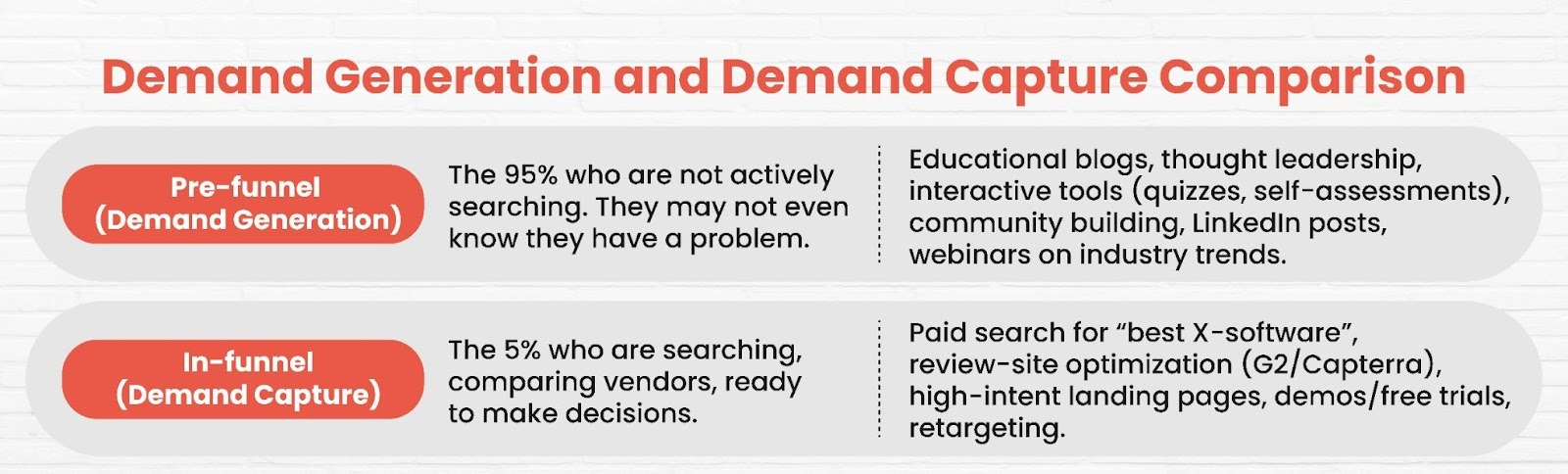
According to research by ONLY B2B, most marketers spend all their time competing over the 5% of their total addressable market that's actively in-market right now. The other 95% aren't ignoring you — they're just not ready yet. And the brands that dominate their categories are the ones investing in both sides of that equation simultaneously.
This guide breaks down exactly how Demand Generation and Demand Capture differ, what each one looks like inside Google Ads, how to budget across both, and what to stop doing if you want the full-funnel engine to actually work.
What changed in 2026
The landscape shifted materially in 2025. At Google Marketing Live in May 2025, Google introduced the "Power Pack" — a three-part campaign framework built around Demand Gen, AI Max for Search, and Performance Max. The strategic implication was explicit: use Demand Gen to build awareness, AI Max to capture search intent, and Performance Max to convert across the full funnel. Google wasn't just launching a new campaign type. It was codifying an entire philosophy of how the two sides of marketing — creating demand and capturing it — should operate in tandem inside a single ad platform.
At the same time, Google's December 2025 data revealed that 68% of Demand Gen conversions come from users who hadn't seen the brand's Search ads in the prior 30 days — directly addressing the long-standing concern that upper-funnel campaigns just cannibalize search traffic. They don't. They reach genuinely incremental audiences that Search campaigns miss entirely.
The practical takeaway: Demand Gen vs Demand Capture is no longer just a strategic philosophy debate. It's a campaign architecture decision with concrete implications for how you set up accounts, allocate budget, and measure results inside Google Ads in 2026.
Definitions and Terminology
Before getting into tactics, it's worth being precise about what these terms actually mean — because they get misused constantly, and the confusion has real budget consequences.
Demand Generation
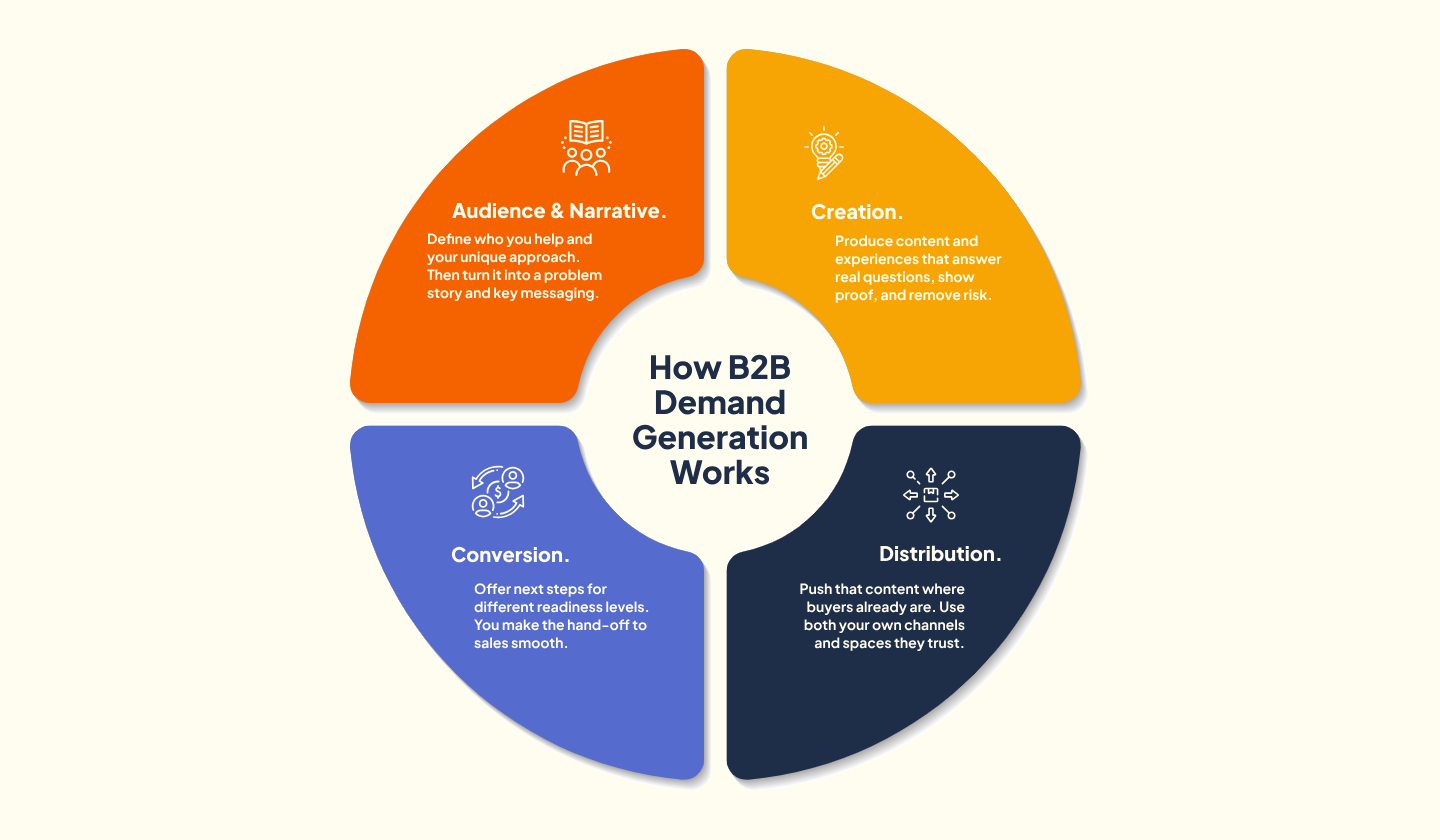
Demand generation marketing definition: it's the ongoing work of creating awareness and interest in your product among people who aren't looking for it yet. The goal isn't a form fill — it's building familiarity, trust, and preference over time so that when a buyer eventually enters the market, your brand is already in their consideration set.
According to Professor John Dawes of the Ehrenberg-Bass Institute for Marketing Science, only 5% of your total addressable market is actively looking to buy at any given moment — a finding known as the 95:5 Rule, published for the LinkedIn B2B Institute in 2021. Demand generation is everything you do to influence the other 95% — the buyers who are learning, following experts, asking peers, and forming opinions long before they type a search query.
This is where the Demand Gen vs lead generation distinction matters most. Lead generation converts interest that already exists. Demand generation creates that interest in the first place. Cognism CMO Alice de Courcy described the shift directly in her book Diary of a First-Time CMO: moving from lead gen to Demand Gen meant stopping the practice of gating all content and instead giving away genuine value freely — because ungated content builds the trust that eventually drives inbound pipeline.
Gartner defines Demand Generation as a marketing strategy focused on driving awareness and interest in a company's products and services — but in practice it goes further than brand awareness alone. A well-run Demand Gen program makes your brand the default answer when a buyer finally decides to research solutions. According to the Voice of the Marketer 2025 survey cited by INFUSE, 26% of enterprise organizations now invest over 70% of their marketing budgets on Demand Generation — a signal that the most sophisticated B2B teams have already shifted their center of gravity upstream.
Demand Capture
Demand Сapture marketing definition: it's everything you do to intercept buyers who already have intent. Someone who types "best project management software for agencies" into Google has a problem, is actively evaluating solutions, and is ready to be captured. That's Demand Capture in search advertising at its purest — paid search, SEO, comparison content, and bottom-funnel retargeting designed to convert existing demand into pipeline.
Demand Capture vs lead generation is a subtler distinction. Lead generation is the mechanism — the form, the call, the meeting booked. Demand Capture is the strategic intent behind it: intercepting buyers at the moment of highest intent and converting that intent into an identifiable lead. You can run lead generation tactics without a Demand Capture strategy, but you'll be competing on price and ad position rather than brand preference.
The Demand Capture vs inbound marketing comparison is worth addressing too. Inbound generates organic demand through content and SEO over months. Demand Capture can be immediate — a Search campaign targeting high-intent keywords can capture demand the day it goes live. Both work. They just operate on different timescales and require different inputs to function.
The cleanest way to hold both definitions in your head: Demand Generation fills the top of the funnel with educated, interested buyers. Demand Capture converts them at the bottom. Run only one without the other and you're either building a brand nobody searches for, or bidding on keywords for an audience that's never heard of you.
Demand Gen vs Demand Capture
The easiest way to understand the difference is to think about timing. Demand generation operates on the buyer's timeline — months before they search for anything. Demand Capture operates on the marketer's timeline — right now, while intent is hot. Both are essential. Neither works well without the other.
Goals, timelines, audiences and offers
According to UnboundB2B's 2025 analysis of B2B buying cycles, companies that balance Demand Generation with Demand Capture see a 70% higher return over a 12 to 24-month period compared to those focused on either strategy alone. The mechanism is straightforward: Demand Generation educates the 95% who aren't ready yet, so that when they finally enter the market, they already know who you are.
The goals, timelines, audiences, and offers look fundamentally different across the two approaches:
-
Demand generation targets the entire addressable market, prioritizes awareness and education, operates on a 6 to 18-month horizon, and offers content, insight, and perspective — not demos or trials.
-
Demand Capture targets in-market buyers specifically, prioritizes conversion and pipeline, operates on a 1 to 30-day window, and offers demos, trials, consultations, and comparisons.
-
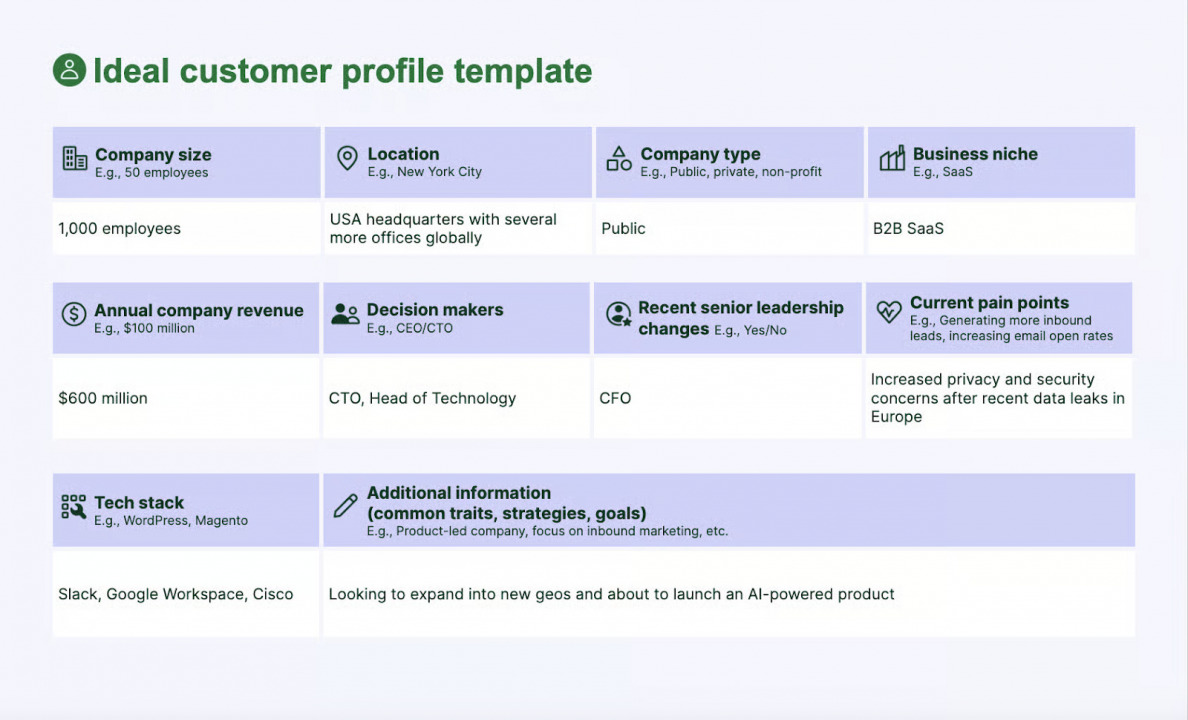
Demand generation audiences are defined by ICP fit — firmographics, job title, industry — not by behavioral signals.
-
Demand Capture audiences are defined by intent signals — search queries, page visits, competitor comparisons, G2 category views.
The Demand Gen vs Demand Capture distinction matters most at the offer level. Running a demo CTA in a Demand Generation campaign is a category error — it's asking for commitment from someone who hasn't yet formed a view on the problem, let alone the solution. The equivalent mistake in Demand Capture is running brand awareness creative at someone typing "best [your category] software for [use case]" — you're telling a story to someone who wants a price. Understanding the Demand Gen strategy vs Demand Capture strategy difference is especially important for SaaS teams deciding where to place the first dollar.
Messaging and creative
The messaging logic follows directly from the audience and timing differences.
Demand generation messaging works on belief, not intent. The creative goal is to make a prospect feel understood — to name a problem they recognize, frame it in a way that reorients how they think about it, and position your category as the relevant solution space. This is brand demand creation vs Demand Capture in its clearest form: one builds the frame, the other converts within it. Demand gen creative looks like thought leadership, original research, provocative points of view, educational videos, and comparison frameworks that don't mention your product until the final frame.
Demand Capture messaging works on proof and friction reduction. The buyer already believes in the category — now they need to believe in you specifically. The creative goal is to answer the objections standing between them and a conversion: Is this company credible? Will this actually work for my use case? What do customers like me say about it? Demand Capture ads lead with social proof, specific outcomes, named customer logos, and clear CTAs. Every word of copy is in service of one action.
As noted by CXL's B2B Demand Generation analysis, the most effective approach builds interconnected content ecosystems of 8 to 12 pieces around a single topic — using progressive disclosure to move buyers from broad industry awareness toward specific, solution-oriented content that showcases your advantage without a direct pitch. That's Demand Generation creative done right: structured, intentional, and built for a buyer who isn't yet ready to be sold to.
Funnel mapping
The upper funnel vs lower funnel marketing split maps directly onto the two strategies:
-
Top of funnel (TOFU) — Demand Generation territory. Channels: YouTube, LinkedIn, Display, podcasts, editorial content, ungated research. KPIs: reach, frequency, branded search lift, content engagement, dark funnel signals.
-
Middle of funnel (MOFU) — transition zone. The buyer has a problem, is researching solutions, but hasn't committed to a category or vendor. Retargeting, email nurture, comparison content, and review site presence all live here.
-
Bottom of funnel (BOFU) — Demand Capture territory. Channels: Google Search, branded keywords, high-intent non-brand queries, competitor comparison pages, G2 and Capterra profiles. KPIs: CPL, conversion rate, pipeline contribution, revenue per lead.
According to 6sense's 2025 B2B Buyer Experience Report cited by ViB, the average point of first vendor contact now occurs at approximately 61% of the buyer's journey — meaning most of the consideration process happens before your Demand Capture tactics ever see them. The brands that win are the ones already present in the buyer's thinking before that 61% mark. That's what Demand Generation is actually for.
Demand Generation examples for B2B that illustrate the funnel mapping in practice: HubSpot built its entire early growth engine on ungated educational content — blog posts, free tools, and templates that attracted millions of people who weren't yet ready to buy CRM software. By the time they were ready, HubSpot was already the default reference point. The Demand Capture layer — paid search, trials, demo requests — converted buyers that Demand Generation had already educated and primed.
Demand Capture examples for B2B look like the inverse: Salesforce's "Salesforce vs [competitor]" comparison pages, Notion's high-intent Search campaigns targeting "project management software for teams," and Zendesk's retargeting ads showing customer testimonials to visitors who viewed the pricing page but didn't convert. These are not awareness plays — they're precision conversion tools aimed at buyers who have already done most of their research.
Google Ads Playbook: Demand Capture
Demand Capture tactics for PPC work because the buyer has already done the hard thinking. Your job is to show up at the right moment, with the right message, and remove friction between intent and conversion.
Keyword strategy
Structure your keyword architecture around intent tiers. Brand terms go in their own campaign — always. Non-brand splits by intent: navigational ("project management software"), comparison ("monday.com alternative"), and transactional ("buy project management tool for agencies"). As Improvado's 2026 Google Ads guide explains, broad match should explore new demand, while phrase and exact match protect your core converting queries. Negative keyword lists are not housekeeping — they're traffic quality control. Review search term reports weekly and expand negatives continuously.
Campaign architecture
Separate brand from non-brand. Separate high-intent from research-phase queries. Branded queries must be isolated to prevent them from cannibalizing acquisition budgets — a common issue when Performance Max and Search campaigns compete over the same queries without brand exclusions in place. The account hierarchy that works is: separate campaigns by funnel stage and intent tier, with tightly themed ad groups that preserve message match between query, ad, and landing page.
Bidding and budgeting
For Demand Capture budget allocation, use tCPA for volume-focused campaigns and tROAS when optimizing for revenue. Assign proxy conversion values based on real pipeline data: close rate × ACV × margin × stage probability. This teaches Smart Bidding to optimize for revenue, not just form fills. Set guardrails: minimum conversion thresholds before switching to automated bidding (typically 30–50 conversions per month per campaign), and cap impression share on branded terms to avoid overspending on traffic that would have converted anyway.
Ad experience
Demand Capture in search advertising rewards specificity. Lead with proof — customer outcomes, named logos, specific numbers. Answer the objection the buyer is holding before they click. Use asset-level reporting (now available after Google's 2025 RSA updates) to identify top-performing headlines and rotate in new variants monthly. Landing pages must match the query's intent precisely — a high-intent keyword driving to a generic homepage kills conversion rate faster than any bid strategy can compensate for.
Measurement
Sitewide tagging via Google Tag is the baseline. Layer in enhanced conversions for leads to bridge online clicks and offline CRM data. According to Directive's B2B guide, import qualified lead and closed-won stages back into Google Ads as separate conversion actions with assigned values — this is what shifts Smart Bidding from optimizing for volume to optimizing for pipeline. Track calls with a minimum duration threshold. Use GA4 as a secondary behavioral layer, not your primary bidding signal.
Google Ads Playbook: Demand Generation (Creating Intent)
Demand generation tactics for paid media in Google Ads run through one campaign type in 2026: Demand Gen. Since July 2025, it absorbed Video Action Campaigns and now covers YouTube (in-stream, Shorts, in-feed, Home), Gmail, Google Discover, and Google Maps.
Audience strategy
Prospecting audiences should be built on ICP fit — job title, industry, company size via Customer Match or similar audiences — not on behavioral signals like "in-market for CRM software." That's Demand Capture logic applied to Demand Generation, and it pulls the wrong buyers. Exclude existing customers and recent converters. As Thomas Eccel, Demand Gen expert cited by Lunio's 2026 strategy guide, notes: "Demand Gen is here to create intent. Performance Max is here to capture it. When you let each one do its job, everything works better."
Formats and inventory
Demand Gen runs across YouTube (all formats), Gmail, Discover, and Maps. Use a mix: horizontal video for YouTube in-stream, vertical for Shorts, static or carousel for Gmail and Discover. Google's February 2026 Demand Gen Drop confirmed that campaigns with "Excellent" ad strength and full asset coverage consistently outperform those with limited creative sets. Minimum recommended asset mix: landscape image (1200×628), square image (1200×1200), portrait image (960×1200), plus video in at least two aspect ratios.
Creative system
The hook must earn attention in the first 3 seconds — no logo, no product shot, no tagline. Open on a problem, a tension, or a data point that stops the scroll. Sequence creative: awareness-level content (problem framing) → consideration-level content (category education) → preference-level content (differentiated proof). Rotate creatives every 4–6 weeks to manage fatigue. According to Google's official Demand Gen best practices, Demand Gen saw a 26% increase in conversions per dollar over the prior year — but that number assumes proper creative setup, not just campaign launch.
Offer ladder
Never ask for a demo from a cold Demand Gen audience. The offer ladder runs: ungated insight or tool → newsletter or community → webinar or event → product education → demo or trial. Each step earns the right to ask for more commitment. Demand Generation examples for B2B that work at this stage: original research reports, free diagnostic tools, template libraries, short video courses — anything that delivers genuine value before asking for anything in return.
Nurture paths
Demand Gen without a nurture path is a top-of-funnel dead end. Capture email at the first content offer, then segment by engagement signal. Remarketing audiences built from Demand Gen video viewers (25%, 50%, 75% watch time) flow back into Search campaigns or into lower-funnel Demand Gen creative. High-engagement video viewers who've seen 75%+ of multiple videos are closer to in-market than most advertisers realize — route them into Demand Capture sequences rather than continuing to run awareness creative. Unlike Demand Capture vs lead nurturing — which operates on leads already in the system — Demand Gen nurture paths work on audiences who haven't raised their hand yet.
Measurement
Last-click attribution kills Demand Gen vs Demand Capture analysis. Use view-through conversions, assisted conversions, and the new "Attributed Branded Searches" metric (available since January 2026) to track how much branded search volume your Demand Gen campaigns are generating. How to measure Demand Generation success: run Conversion Lift studies (now available at lower spend thresholds after the September 2025 Demand Gen Drop), use holdout experiments to measure incrementality, and treat brand search volume growth as a primary KPI alongside pipeline contribution.
Budgeting and Forecasting
The saturation problem
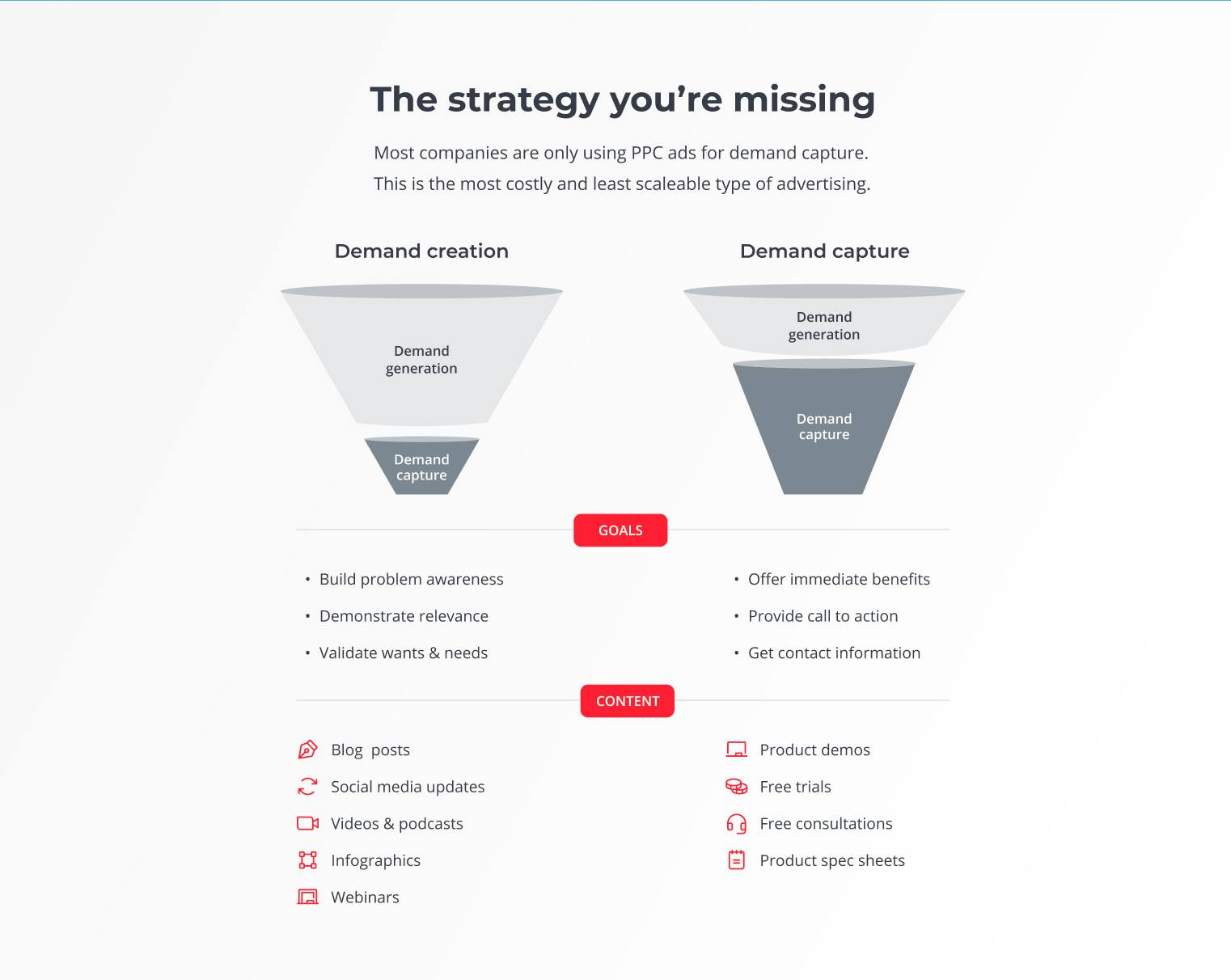
Demand Capture has a ceiling. Once you've captured most of the in-market demand in your category, additional spend produces diminishing returns — more budget chasing the same small pool of ready buyers. This is the Demand Gen budget allocation model problem most teams hit without realizing it: they keep scaling capture while wondering why pipeline growth has stalled. For Demand Gen vs Demand Capture for SaaS specifically, early-stage companies with low brand awareness should lean 70/30 toward generation
Simple budget model
According to The Pedowitz Group's 2026 B2B budget framework, start with 60% Demand Generation and 40% Demand Capture, then rebalance quarterly toward whichever side is producing pipeline at acceptable CAC. For Demand Capture budget allocation, reserve 20–25% of annual budget for monthly reallocation based on real performance data. If CPL is low but pipeline isn't growing, you're overfunding capture — shift dollars upstream into awareness and education.
As a starting point for total marketing spend: 8–12% of ARR for established B2B SaaS, 15–25% for early-stage or low-awareness companies, 5–8% for enterprise with strong expansion revenue. Keep a 10–15% test reserve to explore new formats without disrupting core programs.
Incrementality vs attribution
As Kalungi's 2026 B2B SaaS analysis explains, Google Ads may capture the demand — but it didn't create it. Last-touch attribution assigns 100% of credit to the final click and systematically undervalues everything that built the buyer's preference beforehand. For Demand Generation metrics, track branded search volume growth, assisted conversions, and pipeline influenced — not just CPL. For Demand Capture metrics, track conversion rate, cost per SQL, and pipeline contribution by campaign.
Testing plan
Run Conversion Lift studies quarterly to isolate Demand Gen's incremental contribution. Use holdout experiments — exclude 10–20% of your audience from Demand Gen campaigns for 4 weeks and compare pipeline rates. This is the only way to answer whether your awareness spend is actually moving buyers who wouldn't have converted otherwise.
Common Pitfalls
Measuring Demand Gen with last-click only
According to Kalungi's attribution analysis, most B2B SaaS companies rely on last-touch attribution, which ignores the full buyer's journey and causes budget cuts in Demand Gen programs that are actually driving pipeline. The fix: add view-through conversions, data-driven attribution, and branded search lift as primary Demand Gen KPIs.
Overbuying branded search and misreading ROAS
Branded search campaigns convert well because the buyer already knows you — often because of Demand Generation you ran weeks earlier. Attributing that revenue to paid search inflates ROAS and makes capture look more efficient than it is. Separate branded from non-branded in every report and never use branded ROAS to justify capture budget increases.
Audience overlap and keyword cannibalization
Demand Gen vs Demand Capture campaigns compete when audience lists and keyword targeting overlap. Demand Gen campaigns should exclude in-market audiences and recent site visitors — those belong in capture. Search campaigns should exclude branded terms from broad match expansion. Review overlap monthly using the Audience Manager and Search Term reports.
Creative fatigue and weak landing page-message match
According to 6sense's 2025 Buyer Experience Report, B2B buyers average 28+ touchpoints before a purchase decision. Creative fatigue sets in fast at that frequency. Rotate Demand Gen assets every 4–6 weeks. On the capture side, a high-intent keyword driving to a generic homepage is the single most common reason for low conversion rates — every campaign needs a dedicated landing page that matches the query's intent precisely.
Quick-Start Checklists
Demand Capture checklist
Before launching any Demand Capture campaign, verify the following are in place:
-
Branded and non-brand campaigns are separated with brand exclusion lists applied to non-brand.
-
Negative keyword list covers irrelevant queries, competitor misspellings, and informational searches.
-
Conversion tracking covers form fills, calls (with duration threshold), and booked meetings.
-
Enhanced conversions for leads is enabled and CRM import is scheduled daily.
-
Landing pages match query intent — no generic homepage destinations.
-
tCPA bidding is only active after 30+ conversions per month per campaign.
-
Search term report review is scheduled weekly.
Demand Gen checklist
Before launching any Demand Generation campaign, verify the following are in place:
-
ICP-based audience is built on firmographic signals, not behavioral intent.
-
Existing customers and recent converters are excluded from all prospecting.
-
Creative assets cover all required formats: landscape, square, portrait images plus video in two aspect ratios.
-
Offer is top-of-funnel appropriate — no demo CTA to cold audiences.
-
View-through conversion window is set to 1–7 days maximum to avoid inflated reporting.
-
Branded search volume is being tracked as a primary KPI.
-
Conversion Lift study is scheduled within 90 days of launch.
Conclusion
Demand Gen vs Demand Capture is not a choice between two strategies — it's a decision about sequencing and proportion. Capture without generation means competing on price for a shrinking pool of in-market buyers. Generation without capture means building awareness that never converts because you're not present when intent finally arrives.
According to 6sense's 2025 Buyer Experience Report, 94% of buying groups have already ranked their preferred vendors before contacting any of them. The companies on that shortlist got there through Demand Generation. The companies that closed those deals did it through Demand Capture. Both sides of that equation are required. The only variable is how you balance them for your market, your category maturity, and your current stage of growth.
Start with capture to fund the machine. Layer in generation to expand the addressable audience. Measure both sides honestly — with attribution models that credit the full journey, not just the last click. And rebalance quarterly as the data tells you where the marginal pipeline dollar is working hardest.
FAQ
What is the difference between Demand Generation and Demand Capture?
Demand Generation vs Demand Capture comes down to timing and audience. Demand generation targets the 95% of your market not actively looking to buy — its goal is to build awareness, trust, and category preference over months. Demand Capture targets the 5% who are in-market right now — its goal is to convert existing intent into pipeline as efficiently as possible. Both are required for sustainable growth; running only one produces predictable problems.
Is Demand Capture the same as paid search?
Not exactly — but paid search is the most common Demand Capture channel. Demand Capture vs inbound marketing illustrates the distinction: inbound captures demand through organic search and content over time, while paid search captures it immediately by bidding on high-intent queries. Demand Capture also includes SEO for bottom-funnel keywords, review site presence (G2, Capterra), competitor comparison pages, and bottom-funnel retargeting.
How do you measure Demand Generation ROI in Google Ads?
How to measure Demand Generation success in Google Ads requires moving beyond last-click metrics. Use Conversion Lift studies to measure incrementality, track branded search volume growth as a leading indicator, monitor assisted conversions in GA4, and use the Attributed Branded Searches metric (available since January 2026) to quantify how much search intent your Demand Gen campaigns are generating. Pipeline influenced — not pipeline attributed — is the right primary KPI.
How should you split budget between Demand Gen and Demand Capture in 2026?
The Demand Gen vs Demand Capture starting split for most B2B teams is 60% generation, 40% capture — then rebalance quarterly based on where marginal pipeline is coming from. Early-stage companies with low brand awareness should lean heavier toward generation. Established companies in competitive categories where search intent is high can run closer to 50/50. The signal that you're overfunding capture: CPL looks fine but pipeline isn't growing.
Do Google Ads Demand Gen campaigns equal Demand Generation as a strategy?
No — and confusing the two is one of the most common Demand Gen vs Demand Capture meaning errors. Google's Demand Gen is a campaign type that runs on YouTube, Gmail, Discover, and Maps. Demand generation as a strategy is a full-funnel philosophy that includes content, community, events, podcasts, organic social, and PR — of which Google Demand Gen campaigns are one paid component. Running Demand Gen campaigns without a broader Demand Generation strategy is like running Search without a keyword strategy: the infrastructure is there, but the logic driving it isn't.


