


What Actually Happens When You Duplicate a Google Ads Campaign: Real Affiliate Experiences and Fixes
Technically, two campaigns don't enter the same auction with identical keywords. Google's official documentation states, if multiple keywords match a single search query, the one with the higher Ad Rank at that moment is selected.
However, forum users describe experiences that seem to contradict the documentation. One BlackHatWorld user recounts, as a test, he launched 3 campaigns and noticed CPC spiked after the second campaign went live. The situation left him confused; he couldn't tell whether it was his imagination or whether the keywords were genuinely competing.

A similar case was shared on Reddit by a business owner. He launched two campaigns for different branches of his business. The campaigns were perfect duplicates — identical keywords, identical settings and audience. But the cost per click jumped after creating the duplicate, and both campaigns delivered disappointing results.
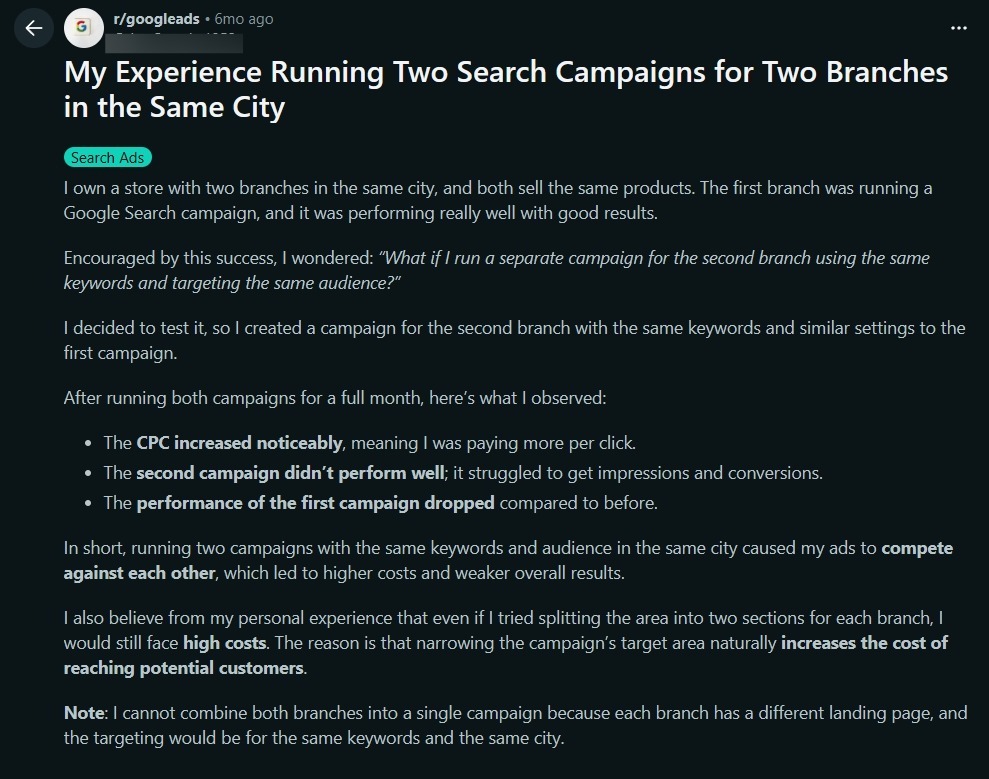
How is this possible if Google itself states that only one keyword should enter the auction? Let's break it down and clarify how to fight CPC increases when duplicating campaigns.
Where Competition Between Identical Keywords Actually Comes From
To understand why CPC rises when keywords overlap, you need to look closely at how Google determines the actual cost per click. The factors at play are:
-
Ad quality
-
Expected CTR
-
Ad relevance to the query
-
Landing page quality
-
Maximum CPC bid
-
Search context — and therefore user intent
-
Clearing the Ad Rank threshold
The higher an ad's Ad Rank, the better its chances of being shown by Google. But a high Ad Rank can also drive up the actual cost per click. In highly competitive environments, Google balances high CPC against profitability for the advertiser.
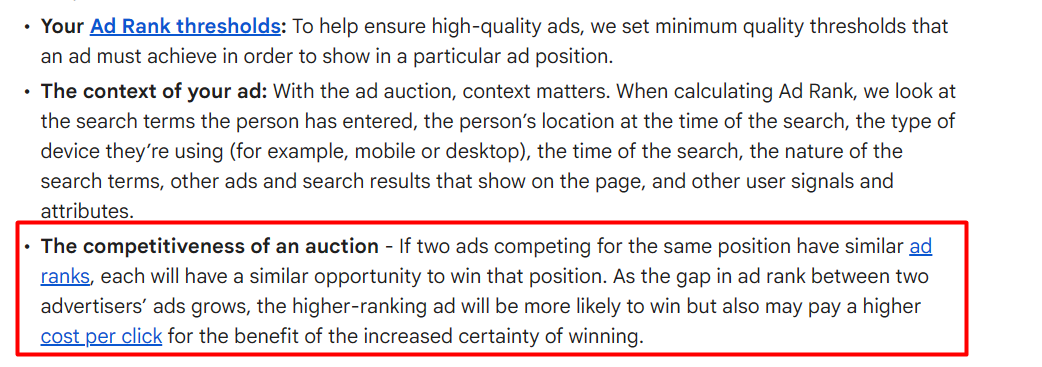
A close reading of the documentation explains the main reasons why identical keywords across different campaigns end up competing. Let’s look at the main factors.
Google May Select the Less Favorable Ad
Say you have two campaigns overlapping on the same time window, audience, website, and keywords. Google then makes an account-level decision about which creative to enter into the auction. Since both Ad Rank and campaign settings influence CPC, when priority is equal, Google may pick the combination with the higher Ad Rank — which can carry a different bid, a different quality score, and a different actual CPC. Forum users confirm this.

CPC rises naturally as a result. The keywords aren't competing in the auction itself — the selection happens earlier, at the account level. The algorithm picks the creatives and keywords with the highest Ad Rank at that moment, and those tend to pull in more expensive traffic.
A Duplicate Campaign Splits the Learning Data
CPC can spike in the short term because the original campaign starts receiving less data for continued learning, while the second campaign has almost none to begin with. Both campaigns are targeting the same traffic — and the new one actually needs it more, since it has to learn before it can match the first. BlackHatWorld users warn about this explicitly.

The result: the algorithm sees the first campaign starved of data and the second campaign barely fed at all. Smart Bidding gets a noisier signal — part of the data stays in the original campaign, part bleeds into the duplicate — making it harder for the system to stabilize bids.
The Account Isn't Properly Seasoned
Media buyers consistently observe that CPC runs higher on fresh accounts than on seasoned ones. One Reddit user noted that bids on a new account were sometimes 3x higher than on an established account with history — even when all settings were copied identically from one campaign to the other.
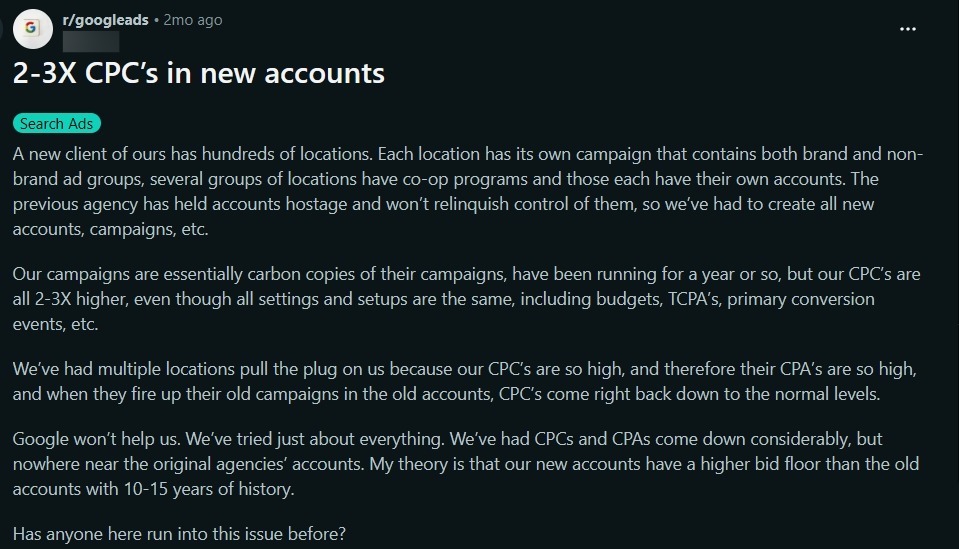
A new campaign needs a body of data to learn from. An unseasoned account with low trust can hit spend limits or restrictions that buyers talk about frequently, which risks attracting significantly less traffic than a trusted account with history would.
How to Counter CPC Increases When Duplicating Campaigns
Media buyers on various forums offer several recommendations for getting CPC under control when running duplicate campaigns. Here's each one.
Build Out Negative Keyword Lists and Keep Them Updated
First, to eliminate competition between overlapping keywords, split them between campaigns and remove the overlap. Separate the campaigns using cross-negatives: add the second campaign's keywords to the first campaign's negative list, and vice versa.
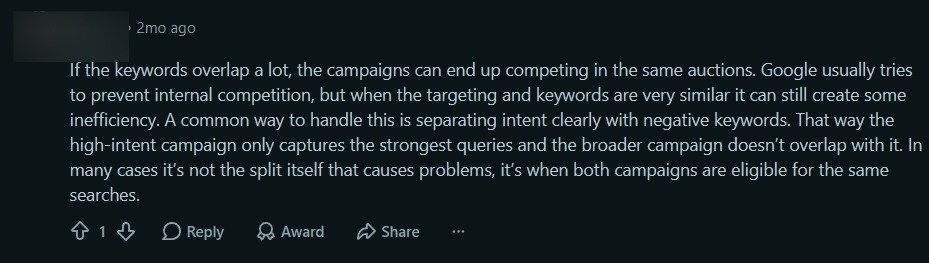
These lists will need regular audits and updates. Done manually, it quickly becomes a grind — you have to review search term reports, move irrelevant queries to negatives, and make sure the campaigns haven't started overlapping again. Scripts are a much cleaner solution: they automate the process and keep the negative keyword lists populated on their own.
But automation only works smoothly when the affiliate has solid infrastructure: an account with history, stable billing, fewer reasons for unnecessary reviews, and above all, an environment that lets you work with the API without friction. Otherwise there's a real risk of getting flagged for "suspicious activity." YeezyPay agency accounts solve this problem through their established positive history. In an agency account, an affiliate's routine activity is far less likely to look like the chaotic behavior of an unreliable advertiser or a bot.
Check Whether the Duplicate Campaigns Can Be Merged
If you're duplicating a campaign purely to target a different intent or dayparting window, it's better not to interfere with the algorithm's learning. Experienced users on the forums recommend merging the two duplicates into a single campaign and splitting by ad groups instead — consolidation brings the algorithms back to a healthy state and removes the risk of unnecessary CPC inflation.
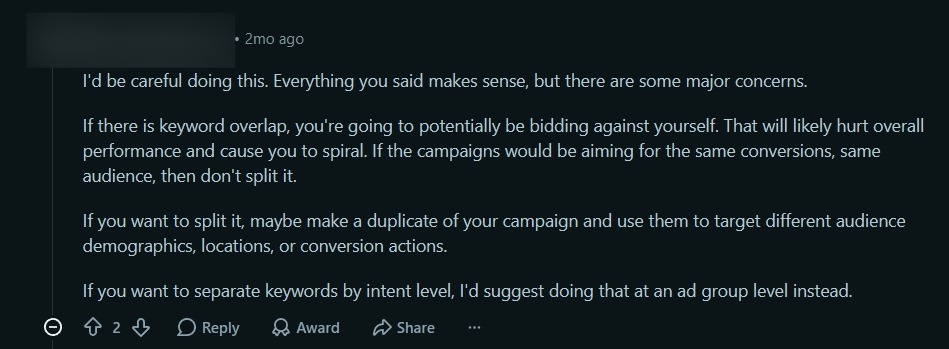
Merging duplicates looks straightforward from the outside. In practice, you'll need to migrate keywords, rebuild ad groups, update negatives, and clear another round of reviews without rejections. The campaign may re-enter the learning phase, ads may get sent back for review, and on self-registered accounts in gray hat verticals, abrupt structural changes like this increase the risk of account suspension.
Which is why merging campaigns requires not just the right structure but the right infrastructure around the account. YeezyPay agency accounts address this directly — they come with history, billing stability, and the groundwork already laid for launches like these. That kind of infrastructure makes the relearning phase smoother, lowers the risk of bans, and means you don't lose the account during a technical restructure.
Bottom Line
Duplicating campaigns with identical keywords shouldn't cause direct auction-level competition. The real problem is usually something else: Google starts deciding which of the overlapping campaigns gets the impression, and the affiliate loses control over where the traffic actually goes. The budget gets spread thin, the algorithm learns from noisier data, and the combination that enters the auction may not be the best one — carrying a different bid, a different budget, or broader match keywords.
To stop burning money, the answer isn't spinning up more copies — it's working through the overlaps: pulling search term reports, separating campaigns with negatives, disabling redundant duplicates. If two campaigns differ only in name and bid, it's better to merge them or split them into ad groups.
On self-registered accounts, that kind of optimization quickly becomes a problem in its own right. While the affiliate is cleaning up overlaps, updating negatives, merging duplicates, and capping spend, the account can run into limits, manual reviews, or an outright ban. You end up fixing the account, not the campaign. YeezyPay agency account infrastructure takes this problem off the table. These accounts carry trust in Google's eyes compared to self-registered accounts and get banned far less frequently. And even if a ban does happen, an agency account lets you calmly move the remaining balance to another account and keep running traffic.


