


Google Ads Not Launching Due to New Account Verification Issues – What to Do?
Media buyers, marketers, and advertisers have been facing an issue of unreasonably long advertiser identity verification for the past year and a half. While this procedure used to take only one or two business days, its duration can now span weeks. For instance, a BlackHatWorld user explicitly points out that they have been waiting four days for a verification decision while customer support ignores them.

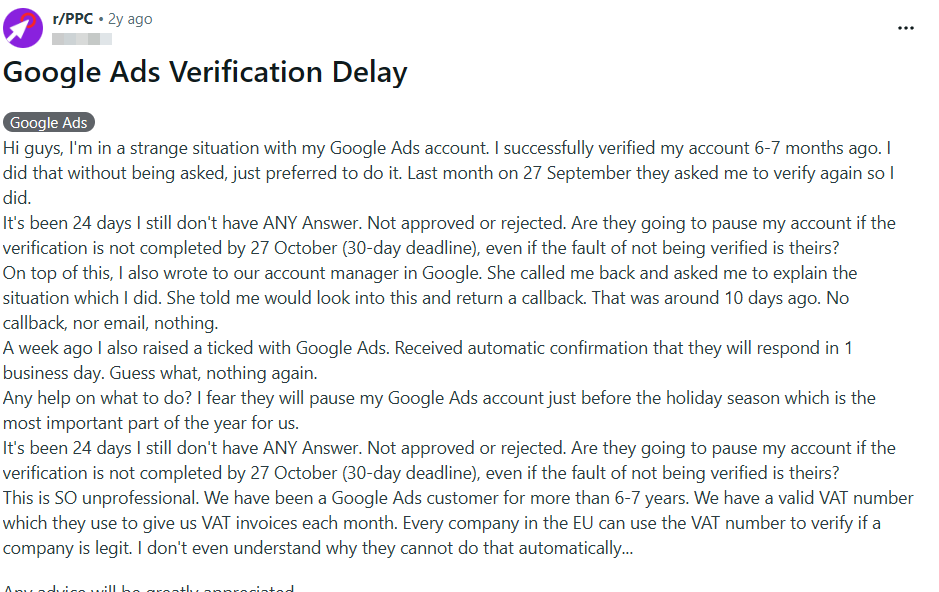
Some users wait for months. For example, a Reddit user waited nearly 30 days for the verification of a warmed-up self-reg account. He was genuinely worried that the account would simply be switched to "Inactive" status because the advertiser verification deadline was approaching. Technical support did not respond – he could only hope for a miracle.
At the same time, most logical actions under delay conditions, such as re-uploading documents or changing the offer, carry the risk of a ban for either circumventing systems or suspicious activity, since advertiser verification implies that the account's trust is very low.
However, it is necessary to intervene in the process – simply waiting will lead to your campaign setup (funnel) being "squeezed out" by competitors. The YeezyPay team analyzed the reasons for verification "hanging": here are the methods to help eliminate it.
Why an Account Gets Stuck at the Verification Stage and What Increases the Risk of Bans
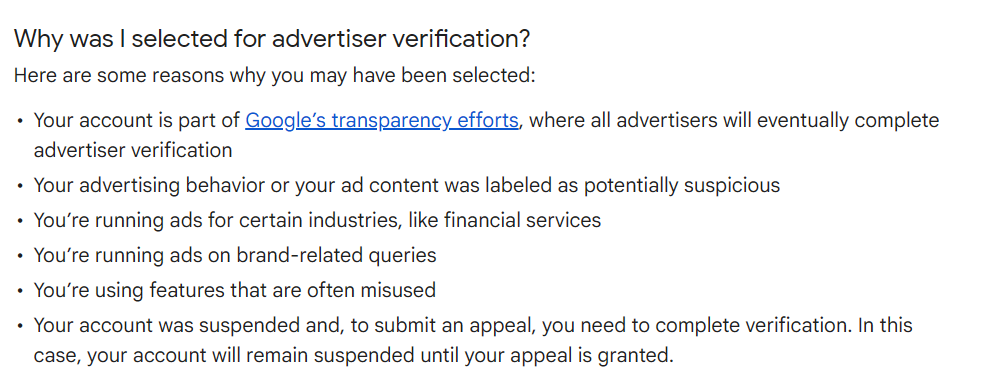
Although Google officially states a "gradual rollout" of verification for all advertisers, in practice, new accounts are the first to undergo checks. The reason is a lack of history ("zero trust"). As stated in the help section, any signal that the algorithms deem "potentially suspicious" (for example, launching ads without a warm-up) is grounds for an immediate advertiser verification request. The same is stated in the "Why was I chosen for advertiser verification?" section.
For successful verification, you must provide documents with completely matching information under the Exact Match Requirements. Matches are primarily required between passport data and payment details. Verification cannot be passed if the data differs even by a single letter.
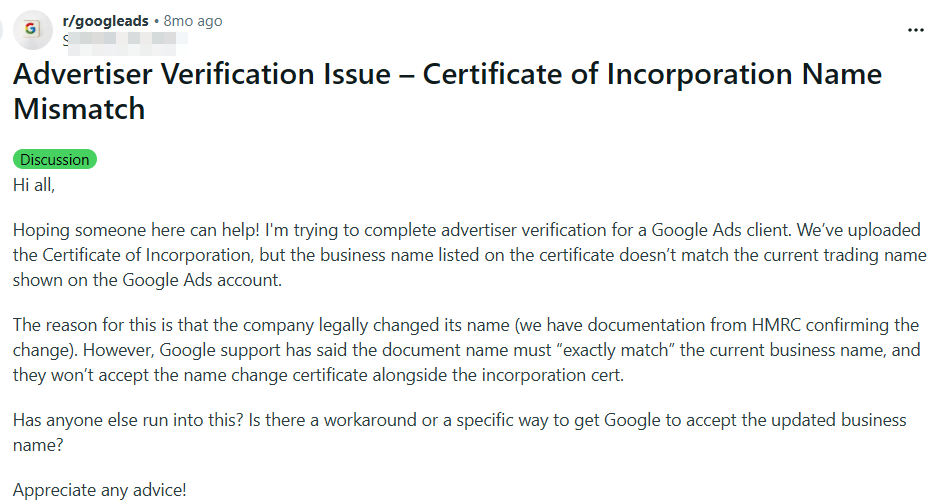
Such strict requirements are linked to numerous complaints on forums. For instance, one user could not pass verification for a company's ad account that had undergone official rebranding and changed its legal name. Support stated that the name in the document must exactly match the current name in the account and refused to accept even a name change certificate as proof of data authenticity.
Previously, if data did not match, the account was blocked immediately. Now, according to information from Agrowth.stick, if Google's AI cannot confirm the correctness of uploaded documents, the account is sent for manual review, which, according to the same source, can drag on for 14 days and sometimes longer. The authors at Agrowth.stick claim that in 38% of cases, excessively long verification is caused by data mismatch.
Media buyers often have the urge to speed up this process: while the account is undergoing verification, time passes, and the campaign loses relevance. But an attempt to influence verification can lead to fatal mistakes. Let's discuss them in more detail.
Major Mistakes of Media Buyers During Excessively Long Account Approval
Attempting to Register a New Account or Delete the Previous One
Often, the first thing media buyers want to do is recreate the account or register a second one. Do not do this: most likely, both accounts will simply be blocked for multi-accounting under the reason "Circumventing systems". Forums also mention that attempting to create a new payment account can lead to a block for "Suspicious payment activity".

During long verification, the account is not dead yet, but an attempt to create a new record will likely kill it with a high degree of probability.
Changing Personal Data or Payment Information
The next common mistake is trying to change personal data or payment information during verification. According to Google, changing data implies that the account owner has changed – meaning verification must be retaken. Furthermore, such actions with low trust become a "red flag" for algorithms: a block for "suspicious payment activity" when abruptly changing payment details is almost guaranteed.
Changing the Offer or Editing the Website
It may seem that excessively long verification is related to the website or offer: as if the algorithms consider the offer not "clean" enough. There is a temptation to make the offer or website more acceptable in Google's eyes.
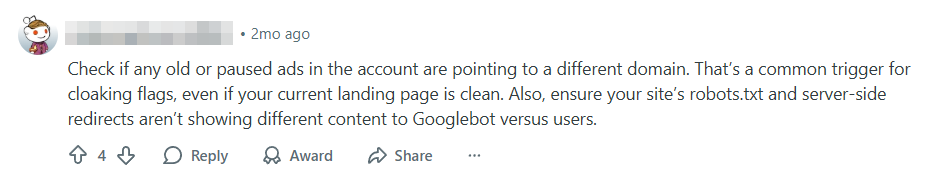
In fact, editing the website during or after verification is strictly prohibited. Experts on forums, for example, point out that changing a domain is viewed by the Google system as cloaking.
And Google documentation explicitly warns against such actions and prohibits them.
How to Speed Up Verification: Three Real Methods
Speeding up verification, however, is possible. Here are three technical methods that give you a chance that the lag will soon end.
Push the Account Through a Smart Campaign
Try launching a Smart Campaign with a budget of $5-10. This can indeed speed up verification – yielding either an approval or a rejection, but at least some result. This method is recommended by some media buyers on BlackHatWorld.

The Google Ads dashboard and specifically advertiser verification do not exist in a vacuum. An account is a complex system of interconnected signals coming from both the user and the algorithms: every user action affects account operation.
Attempting to start a Smart Campaign during verification simultaneously shows moderation that the account is active and has lower check requirements than, for example, a Search Campaign.
Launching a campaign creates a status conflict. On one hand, due to the low requirements for a Smart Campaign, there is a high chance of getting the status "Ad Review passed". On the other hand, the campaign cannot run because verification is ongoing. The algorithm sees that the account is "active" and tries to spend money. As a result, your application becomes more of a priority in the eyes of moderation.
However, one should be aware that the requirement to pass advertiser verification hits accounts with low trust. Attempting to start a campaign could, with low probability, trigger a block for "suspicious activity". For safety, it is more profitable to switch to working with agency accounts: thanks to high trust, such risks are absent there.
Manipulate the Spend
A marketer on Reddit shared a unique experience: during a noticeably long verification, he simply submitted a request to increase the daily spend. And it worked: the account quickly exited the "In Review" status.
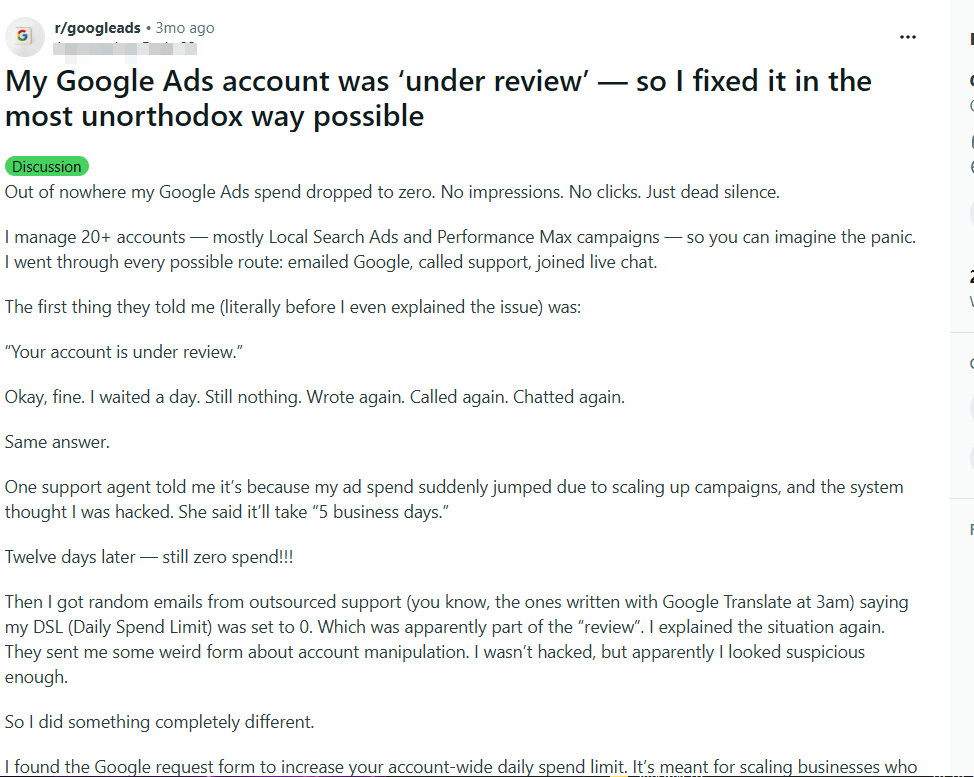
Submitting an application for increased daily spend with an argument like "we are scaling up volumes" is direct proof that your account is active and belongs to a real person. If the increased spend is approved, a status conflict arises: Google will have to check the account as soon as possible.
But remember: spend manipulations force Performance Max to change strategy. This means that when the account passes verification, money will have to be spent again on training the algorithms. In such cases, it is more profitable to use agency accounts: they support API Enhanced Conversion – a system that allows hashing data about users who clicked on an ad. With it, the algorithms will not need to be retrained.
Confirm Payment Details
Confirmed payment details significantly increase trust – so much so that, according to Reddit users' experience, they become necessary even for unblocking an account. And increased trust speeds up verification because moderation looks at high-trust accounts first.
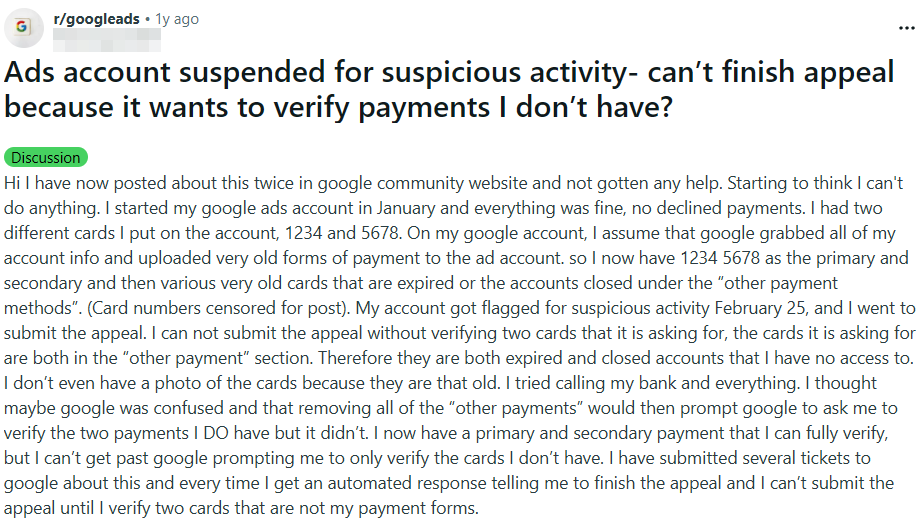
Information about increased trust for accounts with confirmed payment details is also provided by Google documentation. And already high trust allows, for example, launching a "smart campaign" with less risk of getting banned. Therefore, if the "confirm payment details" button is available, be sure to use it. Google will charge you $1.95 and send a code that must be entered in the corresponding field.
Conclusion
Excessively long verification of self-reg accounts is a solvable problem: it is often enough to perform an action that shows the algorithms that the account is alive and can be trusted. However, the account verification process depends on its trust level. For example, on BlackHatWorld, they recommend trying to simply turn off the VPN: supposedly, this already speeds up verification.

It is due to low trust that numerous factors influence the duration of verification – from blurry photos to the use of a VPN or, for example, suspicious payment details. Attempts to speed up verification to get at least a rejection and change documents carry the risk of triggering a block.
However, if you are tired of playing roulette with moderation, agency accounts remain the most reliable option. You won't have to go through verification, warm up the account, or worry over every budget change. While a self-reg account makes you waste time fighting algorithms, YeezyPay allows you to spend it on scaling your campaigns.


