


tCPA and tROAS Don't Work on New Accounts? Why Smart Bidding Burns Through Budget on Accounts With No History
For the past couple of months, media buyers have been arguing about the best way to launch Google Ads on new accounts. Some stick to the old playbook: start with Max Clicks or manual bidding until you get your first conversions, then move to Maximize Conversions, and only after that switch to tCPA or tROAS. Others see this as an unnecessary detour: why buy cheap but not always quality traffic when you can just flip on an automated strategy like tCPA or tROAS right away and let Google hunt for users who are more likely to convert.
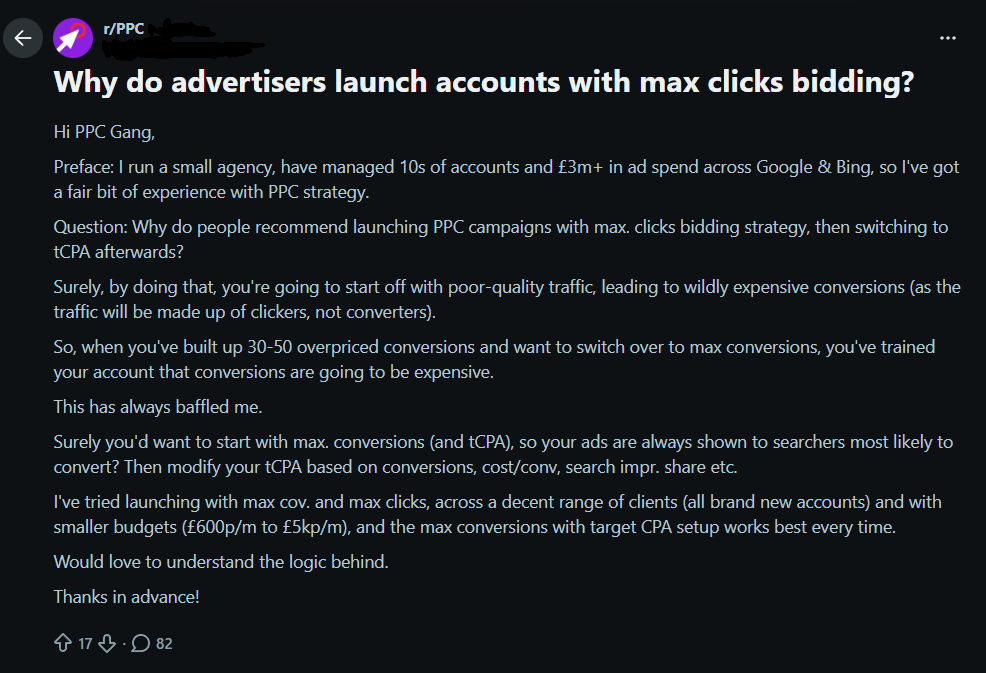
One Reddit thread participant says he's managed dozens of accounts and run through more than £3 million in ad spend across Google and Bing, testing launches on new accounts through both Max Clicks and Max Conversions with tCPA. In his experience, the second option usually performed better. The logic isn't hard to follow: there's no point training an account on irrelevant clicks if the actual goal is conversions, not burning budget to "train" the algorithm.
But there's a flip side to that logic. tCPA and tROAS really can perform well — when the account already has trust, a solid structure, and at least some history behind it. A brand-new account can't give the algorithm any sense of which queries bring in leads, which leads turn into money, which landers convert, and which ones are just racking up clicks.
Today YeezyPay team breaks down why tCPA and tROAS can underperform on accounts with no history, when it actually makes sense to switch on automated bidding, and how to prep your foundation so Google's algorithms learn efficiently.
Why tCPA and tROAS Underperform on New Accounts
tCPA and tROAS look like the perfect setup, even for a beginner: set your target lead price or ROAS, and Google goes off and finds the right audience. But under the hood, things work a bit differently. First, let's look at what separates the two strategies:
-
tCPA. Here, the audience search depends on the conversion price the buyer sets. Say a buyer sets the conversion cost at $30. The algorithm then tries to rack up as many conversions as possible around that bid. If the account already has history, it at least understands which users resemble the ones who converted before. If there's no history, Google starts guessing at the audience.
-
tROAS. The logic behind target ROAS is more involved. The system has to find not just an audience, but traffic that actually generates revenue. In e-commerce, for example, the algorithm looks at order value: if user #1 spent $10 on the lander and user #2 spent $50, Google goes looking for more users like #2. In gray-hat verticals like gambling, crypto, or betting, everything depends on deposit size, upsells, retention, or whatever other parameters the affiliate feeds in.
A new account often ends up stuck in an awkward spot. On one hand, the buyer wants to control CPA or ROAS from day one. On the other, Google hasn't seen any real conversions yet and doesn't actually know which clicks matter. The result: either the campaign barely spends at all, or CPC balloons as the system scrambles to find any conversion it can.
The takeaway is simple: running tCPA and tROAS effectively on a self-registered account or a freshly created account with no history just isn't realistic. Agency accounts have a real edge here — beyond trust, they also come with higher limits and review priority. That lets you collect the conversions you need faster and start squeezing the funnel sooner. To avoid ending up with a sketchy provider, it's smarter to source these accounts through a vetted service. YeezyPay has issued affiliates more than 40,000 accounts over 3+ years in business, including for gray-hat verticals.
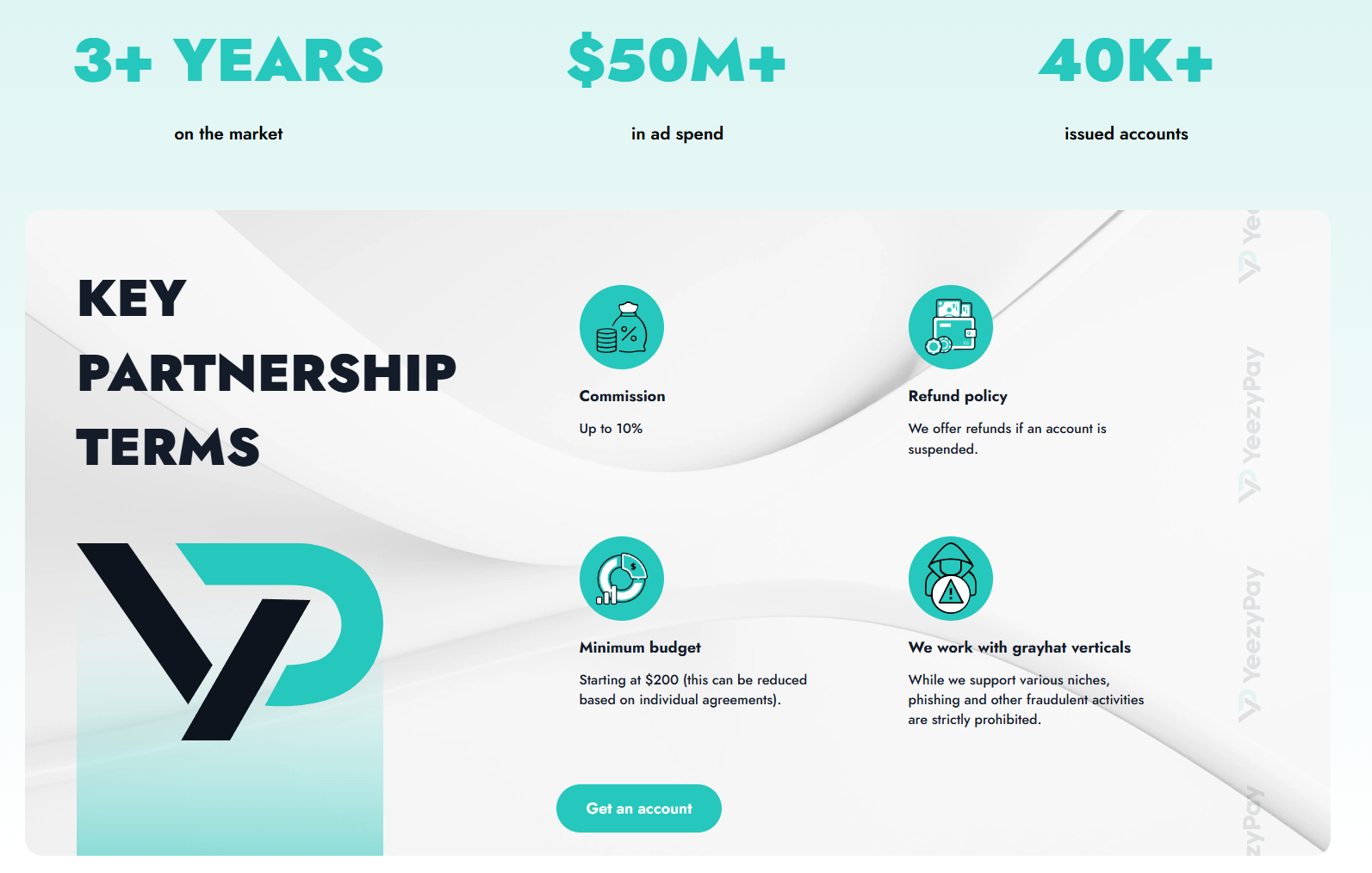
All accounts come pre-verified, so you can start spending real budget from day one and get the most out of your funnels.
When It's Actually Worth Switching to tCPA and tROAS
In the PPC community, the usual rule of thumb is around 30 conversions in 30 days before flipping on tCPA or tROAS. Some practitioners cite different numbers — 30+ conversions for tCPA and 50+ for tROAS over that same window.
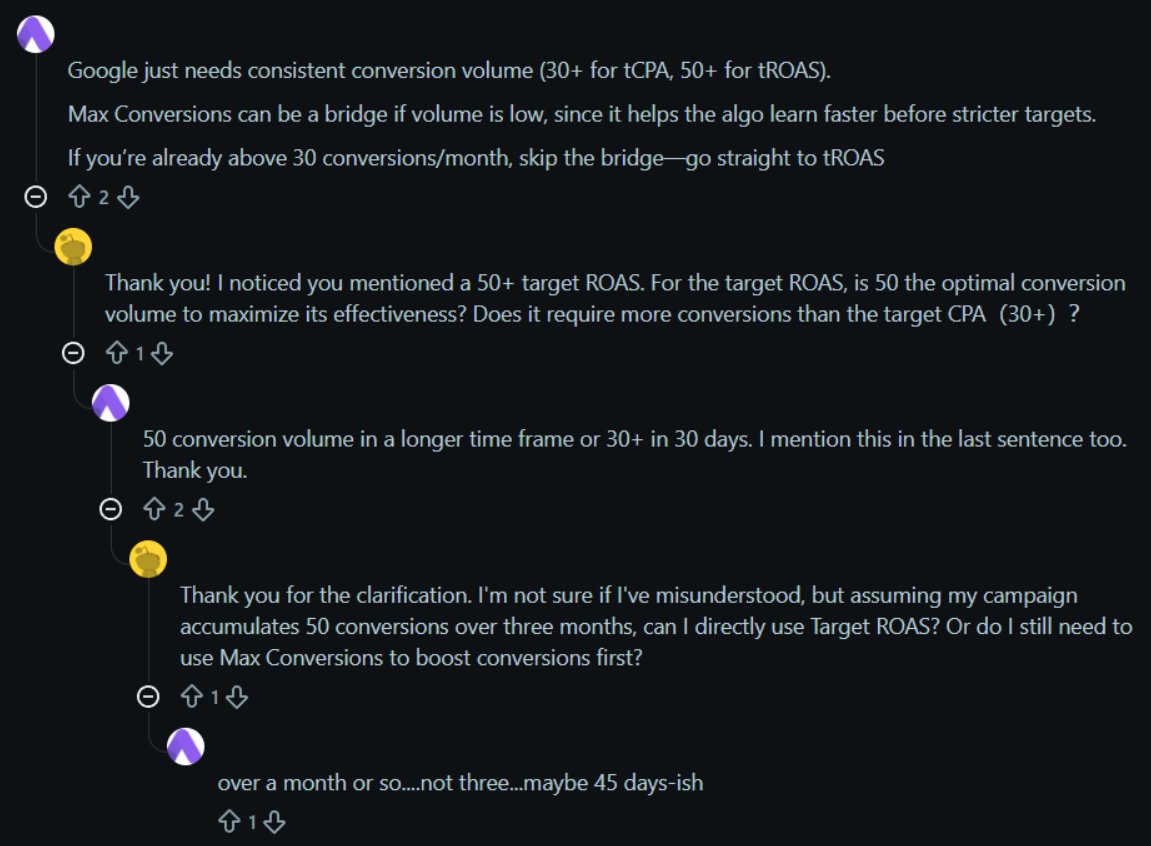
It's worth keeping in mind that these figures aren't a strict rule, just a rough starting point. According to Google's own help documentation, the baseline for tCPA is at least 30 conversions over the past 30 days, while the requirements for tROAS are shown in the screenshot below.
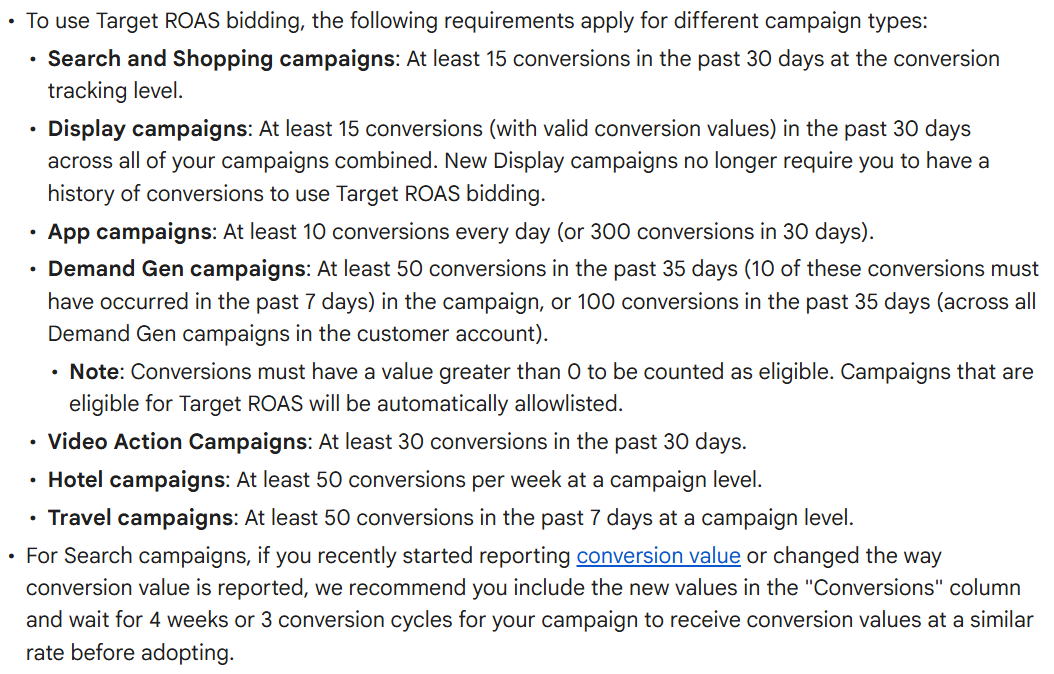
But it's not quite that simple. To run tCPA campaigns effectively, you need to understand the logic behind the bidding algorithm. Say a campaign has been pulling in leads at $70–80 for several weeks. The buyer isn't swapping out the lander every couple of hours, and the targeting is bringing in the right audience. In that case, it makes more sense to set the target close to the actual CPA (say, $69–78) and ease it down gradually from there.
If the real CPA is sitting around $80 and the buyer sets a tCPA target of $30 right away, the campaign can lose impression share fast. The algorithm sees the target, but it doesn't see any proof that price is actually achievable. So it pulls back from auctions, spends less, or starts hunting for an audience so narrow it might not even be profitable.
With tROAS, Google's logic gets even more complex. While tCPA just needs the algorithm to figure out who's submitting leads, tROAS needs the system to understand which leads actually generate profit and which ones are just creating the appearance of activity. So the buyer has to pass Google not just the fact of a conversion, but its value too.
One specialist on Reddit explains this through the lens of linking CRM data with offline conversions. First, the conversion gets recorded, with Enhanced Conversions used where needed to improve attribution. Then the CRM data gets sent back through Offline Conversion Import. Only after that does tROAS actually start optimizing properly.
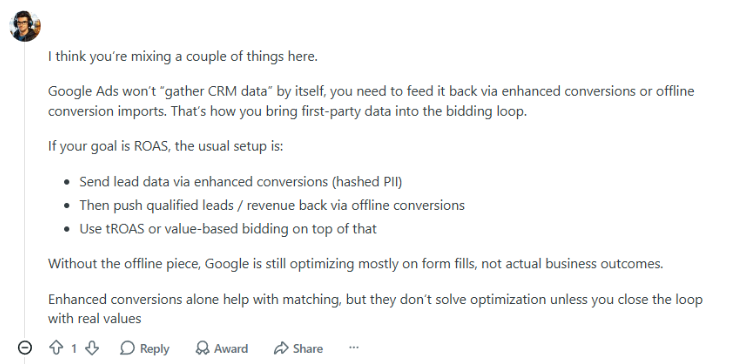
In practice, this can look pretty different lead to lead. One lead might get valued at $20, because the affiliate flagged them as promising. Another user makes a deposit and gets valued at $100, while a third gets hooked enough to generate $500 in revshare over the course of a week. The more precisely the buyer feeds this data back into the ad account, the better Google understands who to look for in the next round of auctions. Essentially, tROAS doesn't learn from the leads themselves — it learns from what happens to them afterward.
How to Build the Right Foundation for tCPA and tROAS: What Practitioners Say
The main job on a new account isn't to flip on tCPA or tROAS right away — it's to feed the algorithm clean signals. Google needs to see a clear chain: which keyword brought in the right user, which ad worked, which lander converted, and what that conversion was actually worth to the business. Here are a few tips that string together into a single workflow.
First, set up conversions properly. It doesn't matter which strategy the buyer eventually wants to run, or what kind of account they're starting on — if the algorithm can't identify the target audience, you can forget about ROI. Open Google Ads and create a new conversion action.
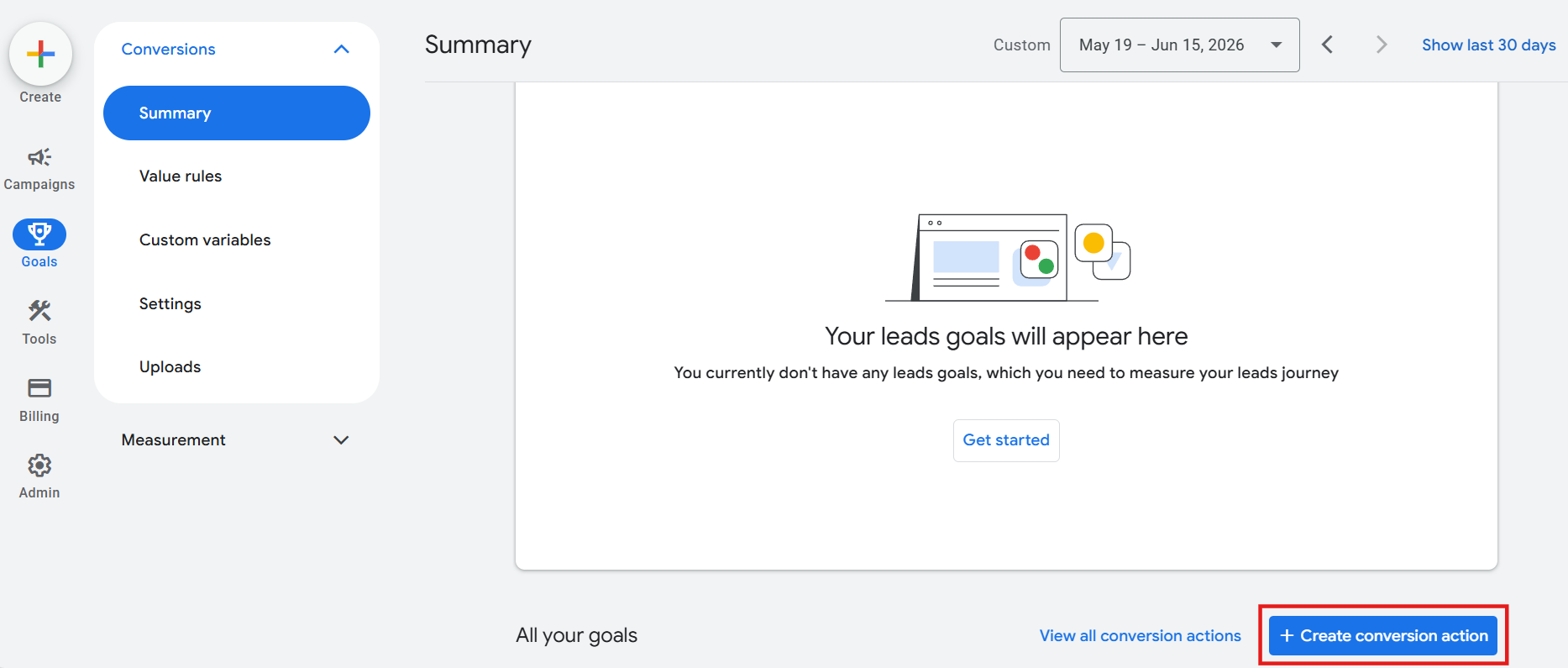
At this stage, don't drag everything into it. Button clicks, page views, scroll depth, form opens, and other micro-events are better left as secondary actions — or skipped entirely for training purposes. Only count what actually moves toward revenue as a primary conversion: form submissions, email confirmations, sign-ups, deposits, and so on.
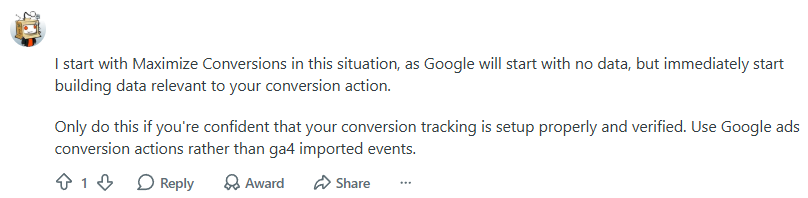
One practitioner on Reddit says that on a fresh account, he only starts with Maximize Conversions under one condition: conversion tracking is already set up and verified. He specifically recommends using native Google Ads conversions rather than imported GA4 events. Yes, the automated strategy can technically launch early — but only if the buyer is feeding it a clean signal.
Next, turn on value tags for every lead. This matters for tROAS, since you'll eventually need to pass along not just the fact of a conversion, but how valuable it was.
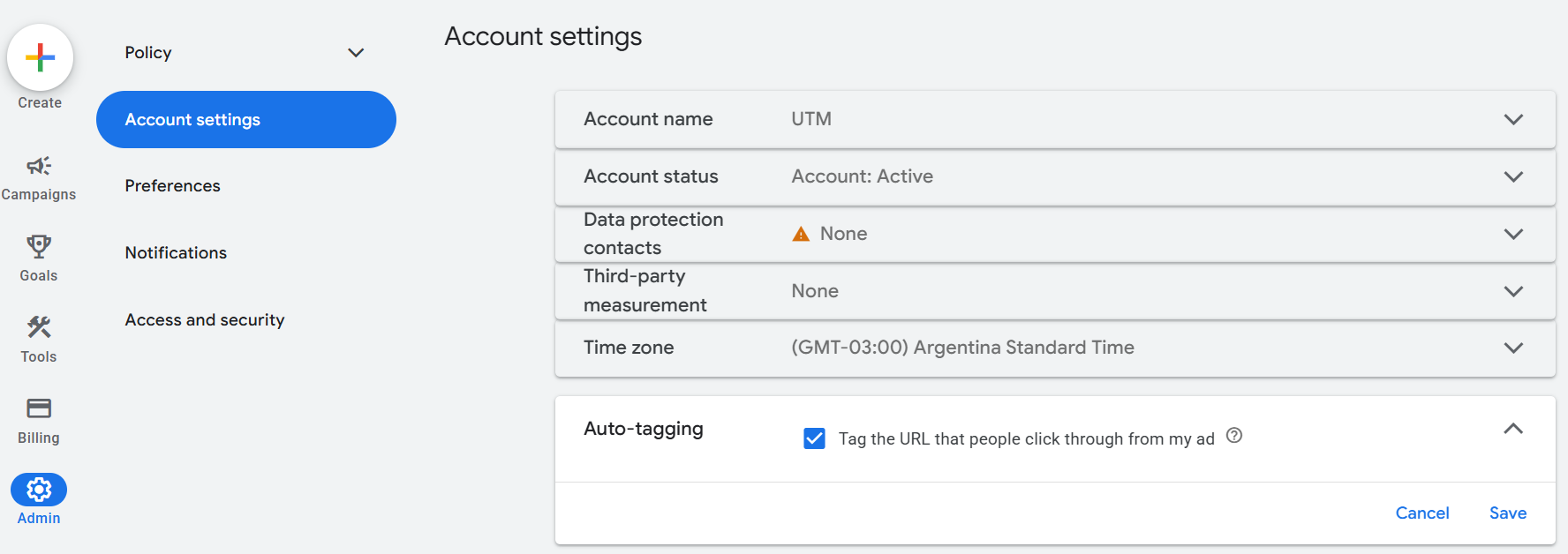
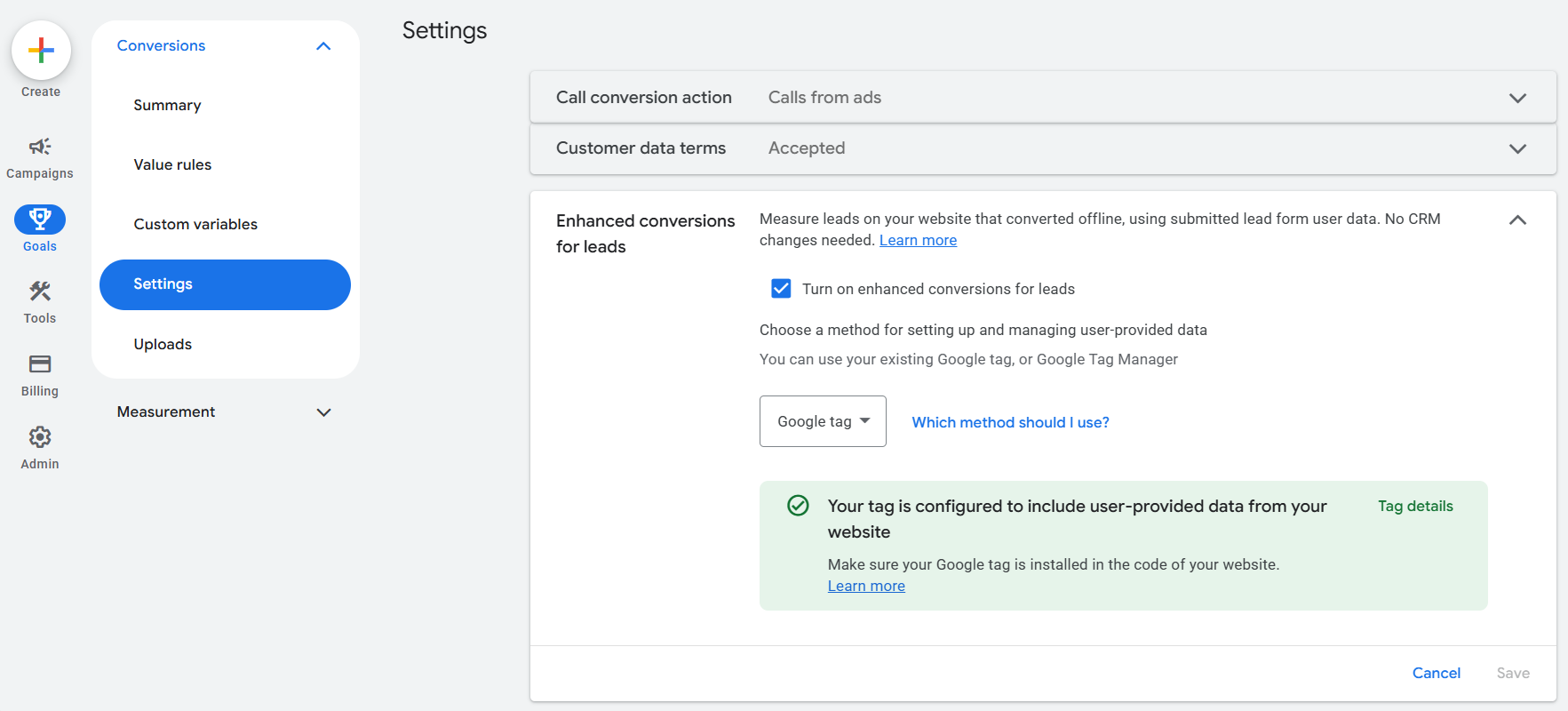
Now you can connect your CRM to Google Ads data. For tROAS especially, it's critical to pass along not just the fact of a lead, but its value. Start by enabling Enhanced Conversions for Leads in your goal settings.
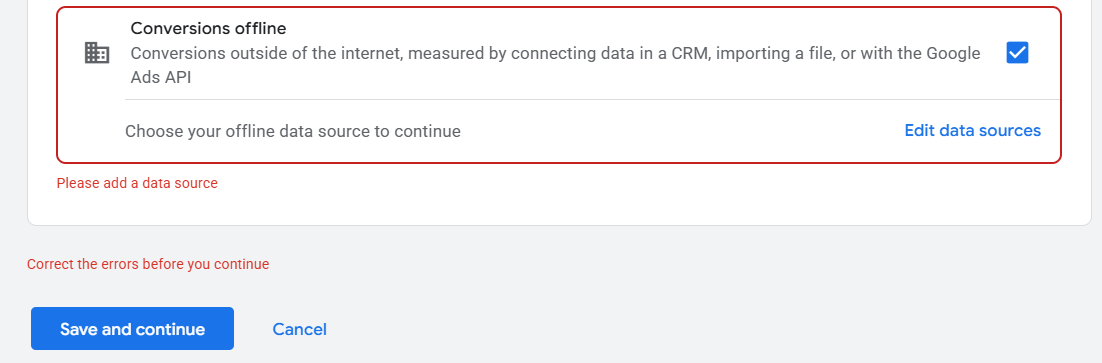
After that, set up offline conversions. Create another new conversion action and scroll down.
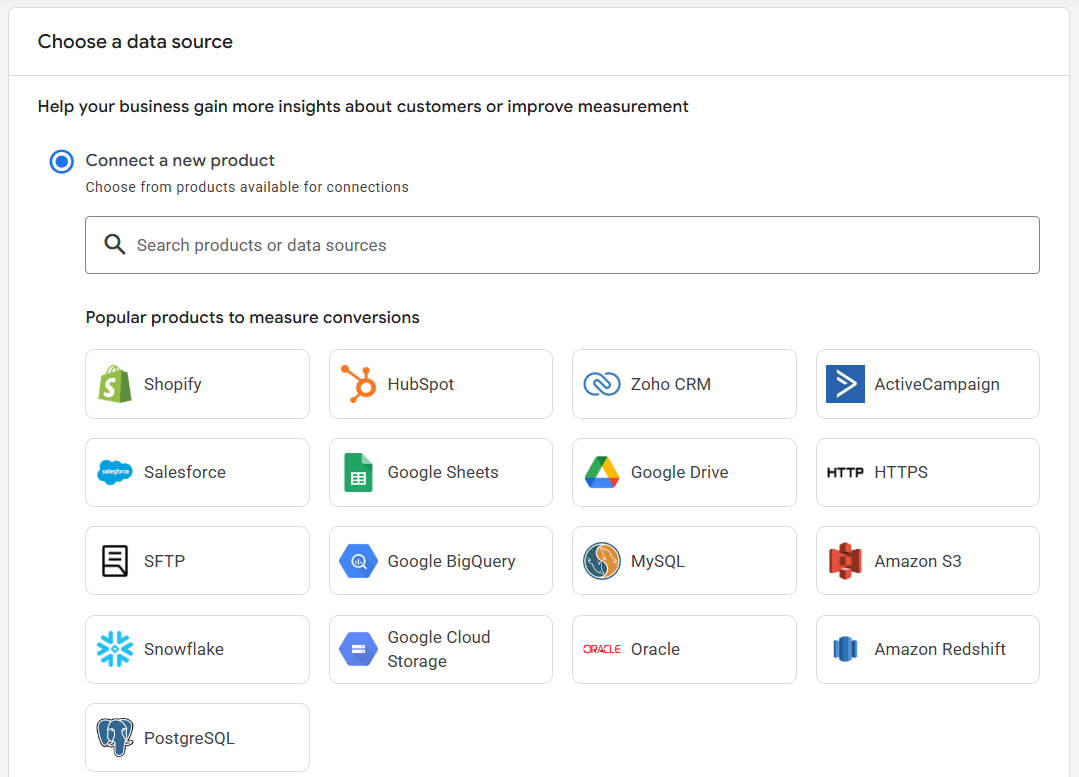
Select offline conversions, then choose the source for those conversions.
Once the foundation's in place, you can launch the campaign. In a new campaign, avoid mixing every intent into a single ad group. Build small, focused groups — 5 to 15 keywords per theme. Brand, sign-up, bonuses, deposit, app, competitor terms — keep them separate. That way Google can quickly figure out which query connects to which ad and which lander.
At launch, skip broad match. If the account is new and barely has any conversions, broad match gives the algorithm way too much room to experiment. It'll start testing tangentially related segments, and the buyer foots the bill for that exploration. So start with exact match, and have your negative keyword list ready to go from day one.
If the budget's tight, you can start with Maximize Clicks and a CPC cap. That keeps Google from immediately buying up expensive clicks and lets the buyer build an early picture of search query performance faster.
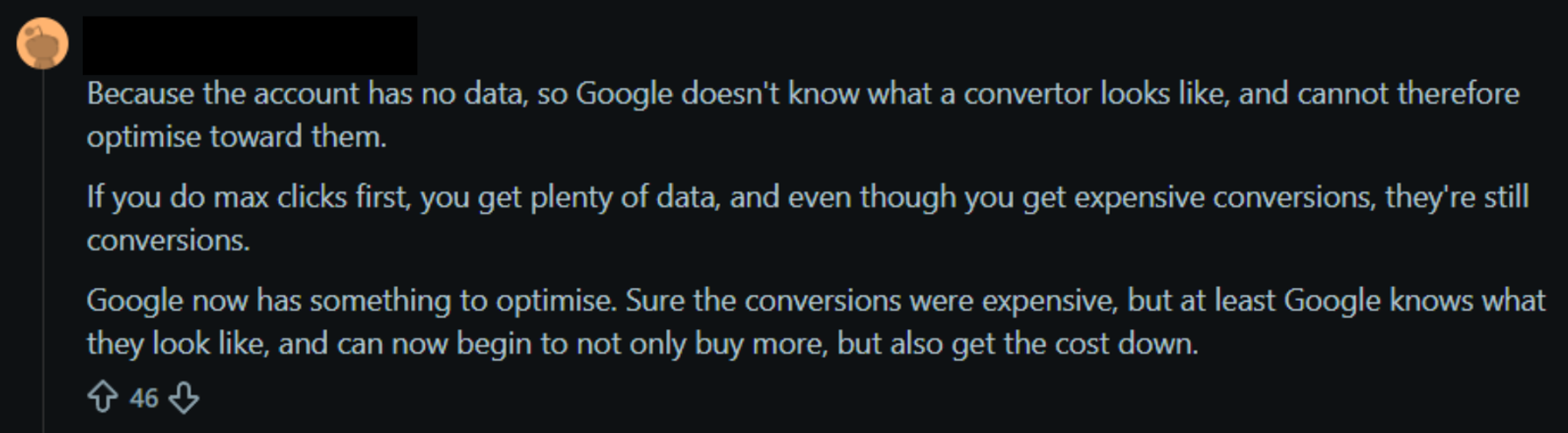
Participants in the Reddit discussion note that Maximize Conversions usually works once budget and conversion volume are high enough to support it. But if the account doesn't have much data yet, they recommend Max Clicks instead. The same specialist also suggests starting with Exact Match, building out a negative keyword list, and only expanding once there's real data on what's working.
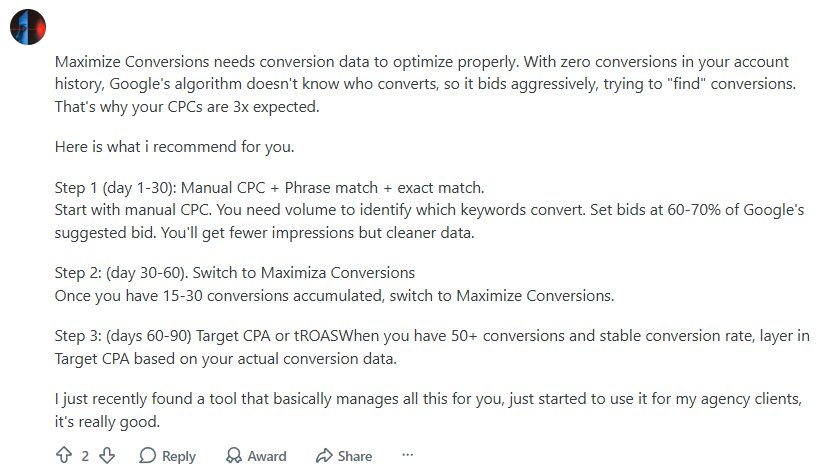
After launch, check the search terms report every day. Open up search terms inside the campaign or ad group and see exactly which real queries Google matched the ads to. From there it's pretty straightforward:
-
Query converted — add it as its own exact-match keyword.
-
Query looks borderline — keep watching it.
-
Query has obviously irrelevant intent — add it to negatives.
-
Query spends money with no leads — check it individually and decide whether to cut it or move it to a different group.
After a few days, move on to Maximize Conversions. Once the campaign has collected its first clicks, negative keywords, clear search query data, and early conversions, it's time to test it.
Maximize Conversions gives Google more freedom; the algorithm tries to get as many conversions as it can within the budget. tCPA, on the other hand, puts a price ceiling on things immediately. If that ceiling shows up too early, before the algorithm has built up enough of a foundation, the campaign can lose impression share.
One specialist on Reddit says that on a new account, he typically starts with Maximize Conversions if tracking is dialed in and the keywords are bringing in the right intent. He recommends a mix of Exact and Phrase match, and adding negative keywords quickly. In other words, Maximize Conversions can be a solid starting point — but only once the buyer already has control over signal quality.
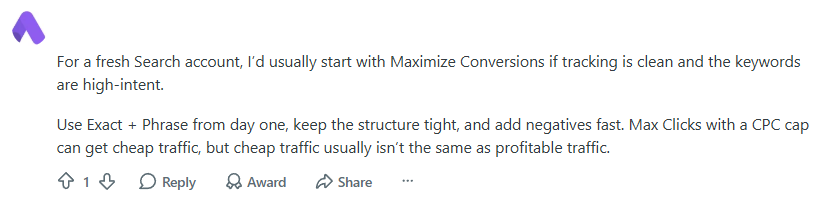
Once the campaign is consistently generating conversions, look at the actual CPA over the past few weeks. If leads are coming in around $100, setting a tCPA target of $15 doesn't make sense — Google won't have any history to back up that price. Set the first target close to the real CPA, or just slightly above it. Once the campaign stabilizes, gradually bring the target down.
In one discussion, a user recommends starting tCPA slightly above the desired CPA. If the buyer wants leads at $30, they might start at $40–45 and ease the target down from there. That gives the algorithm room to work without choking the campaign right after the switch.
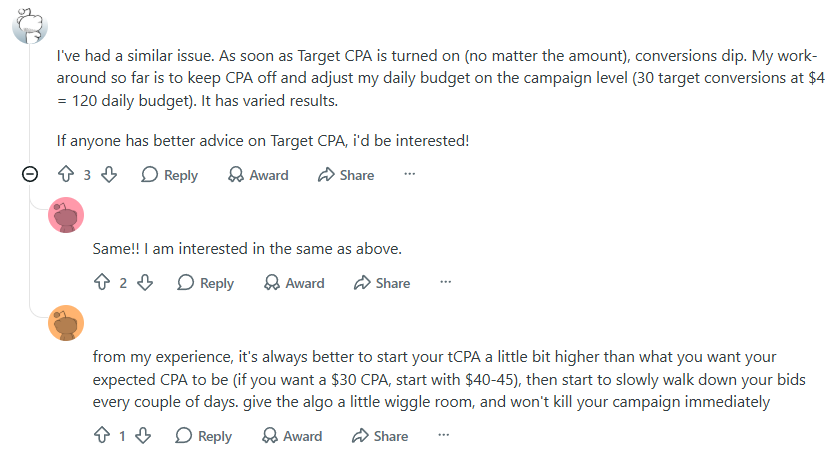
If the buyer is happy with both the audience quality and the price under tCPA, switching to tROAS becomes optional, depending on what the affiliate is actually trying to achieve. Whichever automated strategy gets used, the key is not to tinker with it every half hour — that just throws off Google's learning.
A sound approach looks like this: make a major change, then give the campaign time. And "time" here means days or weeks, not a single day, depending on traffic volume and how long the sales cycle runs. If leads come in every other day and approval takes a week, you can't judge tROAS performance after 24 hours.
One affiliate describes the most cautious path as a ladder: manual bidding until clicks stabilize, then Max Clicks, then Max Conversions until you hit 30+ conversions in 30 days, and only then tROAS or tCPA. He notes separately that the whole process can take more than two months once you factor in A/B testing.
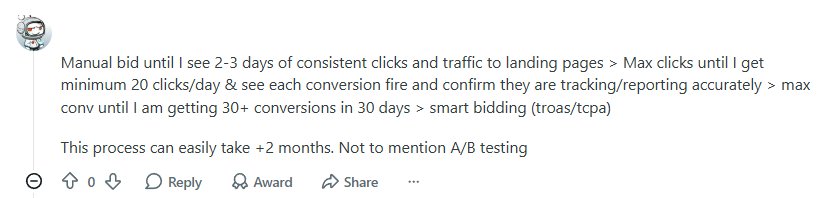
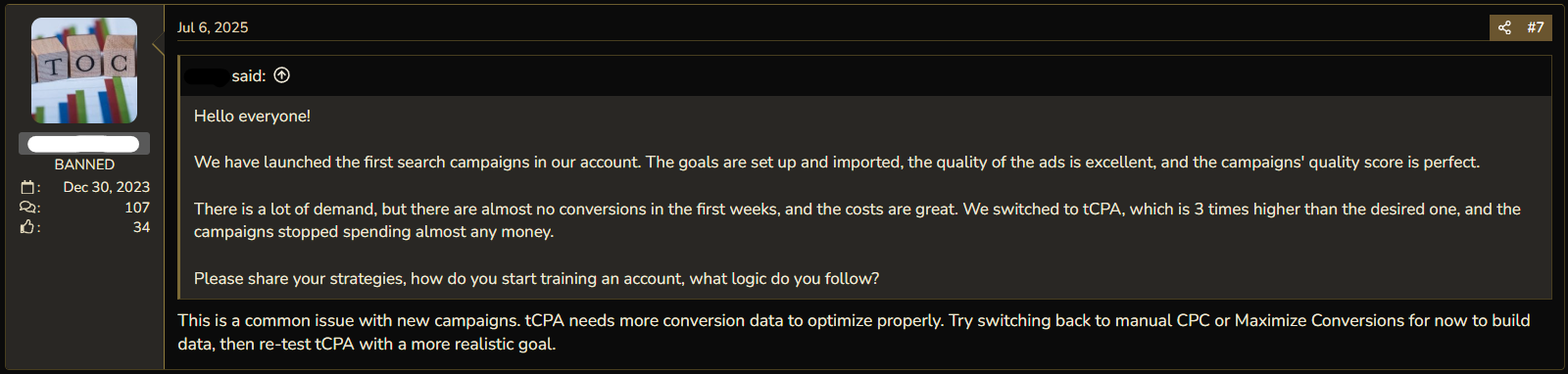
If a buyer turns on tCPA and the campaign basically stops spending, there's no need to tear everything down and start over. First, check three things: is the tCPA target too low relative to what Google suggested, is the budget actually sufficient, and does the campaign have a real conversion history. On BlackHatWorld, one participant in a discussion notes that tCPA sometimes needs more conversion data to optimize properly — his advice is to temporarily fall back to Manual CPC or Maximize Conversions, build up more data, and then test tCPA again with a more realistic target.
All this prep work isn't just about settings — it's also about operations. While the buyer is building the foundation for tCPA or tROAS, they're testing different ad groups, landers, GEOs, offers, and budgets. If the account can't spend properly, holds up payments, or gets banned quickly, the campaign never gets the chance to collect enough data. YeezyPay provides access to agency Google Ads accounts, runs through 10+ MCCs across different countries, lets you track spend right inside the platform, and refunds funds if an account gets suspended. That makes it a reliable partner for both solo buyers and affiliate teams who need to quickly test a few hypotheses, gather the first 20–30+ conversions, and then move on to tCPA or tROAS with confidence.
Final Thoughts
tCPA and tROAS genuinely help control conversion cost and ROAS, but they only deliver once a campaign already has a solid foundation. Without proper tracking, a curated keyword list, and optimized landers, running traffic through these automated strategies isn't the best idea.
On a new account, the algorithm first needs to work out which queries bring in people with the right intent, which clicks turn into leads, and which conversions actually generate revenue. That's why it's smarter to hold off on strict CPA or ROAS targets until after an initial test period, rather than setting them on day one. The buyer collects data first, cleans up search queries, checks tracking, and gets a real read on the unit economics. Only then does it make sense to gradually shift to tCPA or tROAS and carefully tighten the targets.
That said, results don't just depend on Google Ads settings — they also depend on how fast the buyer can actually start testing hypotheses. If every launch gets bottlenecked by hunting for an account, manually negotiating with a seller, or waiting on access and top-ups, collecting that first batch of conversions drags on. For automated strategies, that delay matters a lot: the longer it takes a campaign to reach clean data, the longer the algorithm is flying blind.
YeezyPay has solved this whole headache: the buyer signs up through a Telegram bot, tops up their balance, gets access to an agency account by email, and moves straight into launching campaigns without a long manual setup process. For the buyer, that cuts down on operational overhead — less time spent on logistics, and more time spent testing funnels, collecting conversions, and building the foundation for tCPA or tROAS.


