


How Quality Score Affects Ad Costs and ROI — and How to Improve It
Any media buyer has run into this at least once: Google Ads is burning through the budget just fine, but the click volume is noticeably lower than expected. The account settings haven't changed, the campaign wasn't touched, the limits are the same as always. A similar case came up recently on one of the affiliate forums.
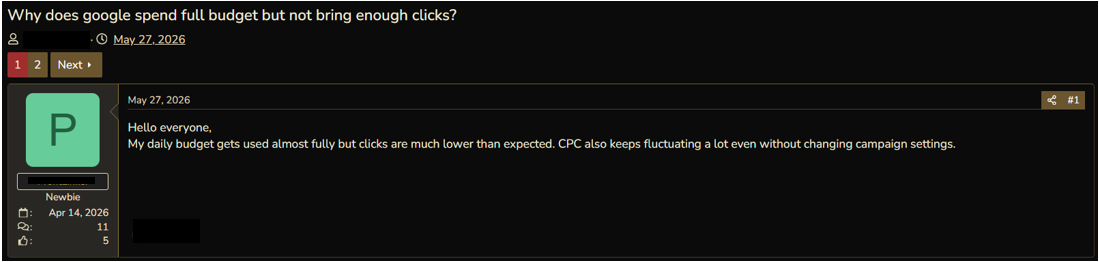
In the comments, affiliates pointed to several possible causes: expensive auction dynamics, heavy competition, overly broad keywords, aggressive auto-bidding strategies, and low Quality Score. This article breaks down how Quality Score affects ad costs, why it tanks ROI, and what you can actually do to pay less per click.
How Quality Score Affects Ad Costs and ROI
Quality Score is a Google Ads metric that reflects ad quality at the keyword level. It's built from three components: expected CTR, ad relevance, and landing page experience. Google itself acknowledges that Quality Score doesn't directly participate in the auction — but it does help you understand where your ads, keywords, or landing page are losing ground to competitors.

When Quality Score drops, Ad Rank follows. The underlying logic matters here: every time a user submits a search query, Google calculates the Ad Rank for every auction participant. That final value is determined by a range of variables — bid, landing page quality, auction competitiveness, search context, and ad quality. In practice, Ad Rank is what decides where your ad appears and what you actually pay per click.
Quality Score also affects advertising costs. Google doesn't hide this, and affiliates have confirmed it in the field: when Quality Score falls below 6, Google automatically pushes CPC up.

Once the cost of entering the auction rises, ROI starts to erode. Here's a simple illustration. Say a media buyer allocates $500 to one campaign. At a CPC of $2.50, they get 200 clicks in an ideal scenario. At a 5% conversion rate, that's 10 leads. With CPL at $80, revenue comes to $800 and ROI lands at 60%.
Now change only the CPC. A weak ad-to-landing-page connection or poor ad quality pushes the click cost to $5. The same $500 budget now buys 100 clicks. Conversion rate stays at 5%, so you get 5 leads and $400 in revenue. ROI drops to -20%.
In that situation, buyers have to move fast: rebuild ad groups, test new copy, audit the landing page, scrub Search Terms, and carefully adjust bids. But all of that work is pointless if the account can't handle a normal optimization pace. On weak self-registered accounts, frequent edits, rising spend, and parallel tests often don't lead to lower CPCs — they lead to limits, reviews, or a banned account.
That's why experienced teams tend to reach for trusted agency accounts rather than self-regs. Google treats these accounts without issue even if campaign settings change every ten minutes. The point is that ads run under real agencies with official Google partnerships. Through YeezyPay, you can get verified agency accounts that are ready to go from day one. The service has access to 10+ agency MCCs across different countries, which makes it easier to pick the right account, start testing quickly, and skip warming up personal or self-registered accounts. That gives advertisers a stable foundation to test creatives without worrying that the whole operation stalls at the first round of edits.
Why Quality Score Drops
Quality Score declines for a range of reasons. Google evaluates not just what an affiliate is willing to pay per click but how well the ad matches user intent, how compelling it is to click, and how well the landing page delivers on what the ad promised. It's worth working through the problem across several dimensions:
Weak connection between keyword, ad, and landing page. Say a media buyer targets the phrase "best online casino Spain" but writes generic ad copy along the lines of "Play and claim bonuses." After the click, the user lands on an offer aggregator with no real focus on Spain — no local payment methods, no local currency, no Spanish-language content. For the user, it's a gap between expectation and reality: they had a specific need and got a generic page instead. For Google's algorithms, it's also a bad signal — the ad and landing page don't answer the query closely enough. Both ad relevance and landing page experience take a hit.
Too many unrelated keywords in one ad group. If a single group contains "online casino Argentina," "casino no deposit bonus," "casino reviews," "best slots," and "casino app," it's nearly impossible to write one strong ad for all of them. Each query carries a different intent: some users are choosing a platform, others are hunting for bonuses, and others are just browsing reviews. Showing everyone the same generic copy means it misses the mark for every audience segment. CTR drops, relevance suffers, and Quality Score starts dragging the whole campaign down. Google itself recommends splitting keywords like these into separate groups — sign-up, bonuses, reviews, app, brand terms, competitor terms, and so on.
Low expected CTR. Expected CTR estimates how likely users are to click your ad when it is shown for a given search query. If ad one shows fast withdrawals, local payment options, a welcome bonus, and geo-specific support, while ad two says something like "Bet with us, win big, have fun" — the user's choice is obvious. The goal is finding the right balance: compelling enough to drive clicks without triggering policy flags.
Polluted keywords. Even if your keywords look intent-aligned on paper, actual Search Terms data can pull in a completely different audience. A campaign targeting commercial queries might see terms like "what is a casino," "how do slots work," "reviews," "scam," "complaints," "no deposit bonus," or "casino jobs" showing up in the report. To Google's AI, these may all fall within the same topical cluster — but for the media buyer, these represent very different users with very different values.
Experienced users on affiliate forums recommend looking beyond spend figures to the full picture: expected CTR, actual CTR, and which specific terms are appearing in the Search Terms report. Often the issue is non-relevant traffic leaking in through overly broad keyword choices.

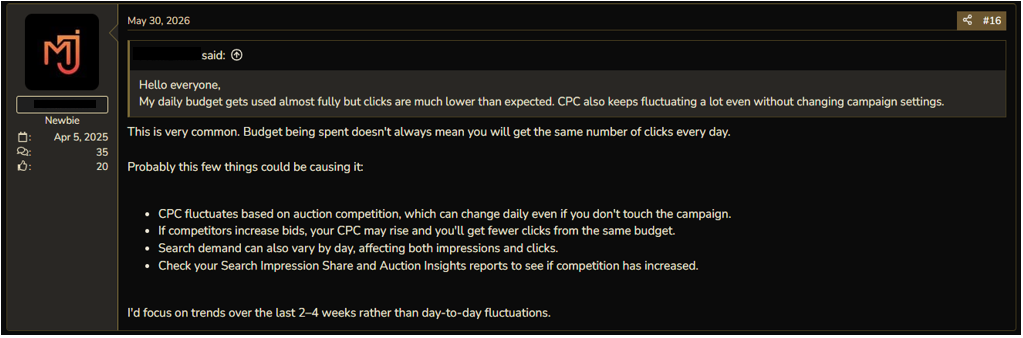
One forum participant made a point worth repeating: not every CPC spike is a Quality Score problem. Click prices can rise due to auction competition, higher bids from other advertisers, or demand spikes on certain days. That's why experienced practitioners look at trends over two to four weeks rather than day-to-day swings. If Quality Score and campaign structure haven't changed but clicks suddenly got more expensive, check Auction Insights and Search Impression Share. The problem might not be inside the campaign at all — the market may have simply gotten more competitive.
How to Raise Quality Score and Stop Overpaying for Clicks
One key point worth restating: a high Quality Score either reduces CPC or, at the very least, prevents Google from artificially inflating it. Practitioners on affiliate forums consistently agree on one thing — if Google burns through the daily budget but delivers few clicks, the answer isn't just raising the bid. You have to find where exactly the connection breaks down. Maybe the keywords are too broad, the ad doesn't match intent, the landing page doesn't follow through on the ad's promise, or an auto-bidding strategy is pushing CPC up faster than the campaign can accumulate useful signals.
Working from simple to complex, start by looking at Quality Score's three components separately: Expected CTR, Ad Relevance, and Landing Page Experience. These can be surfaced by adding the relevant metric columns directly in the Keywords section of the interface.
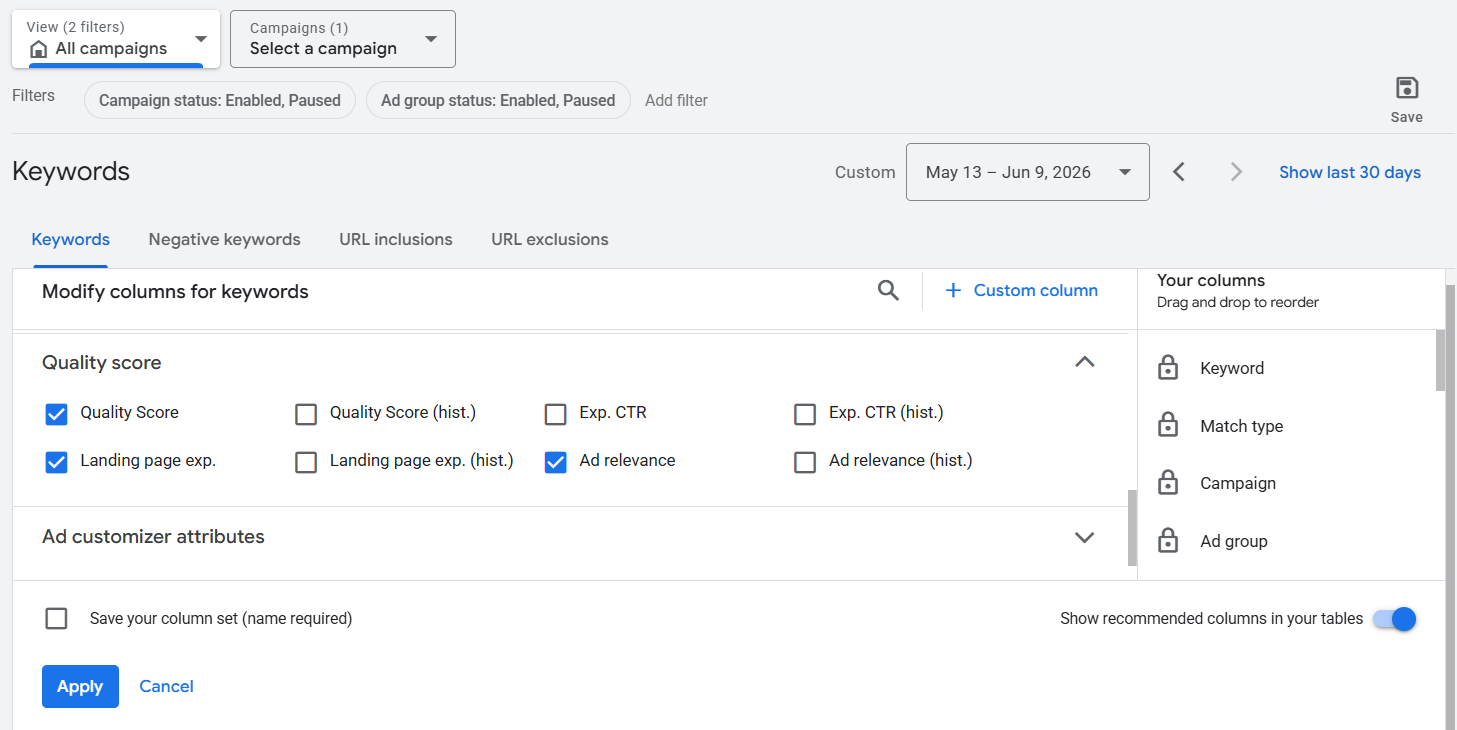
Once added, individual columns will appear in the reporting view.

As the campaign runs, each keyword will show a status for each metric: below average, average, or above average. Here's what to do when one of them underperforms:
Expected CTR. If this is below average, the problem usually lies in the ad itself — it may be too generic, fail to stand out from competitors, or not closely reflect the way the query is phrased. The fix is testing new headlines, adding specifics, leading with a concrete USP, and tightening the connection between the ad and the keyword's intent. For a query like "online casino Portugal fast withdrawal," generic copy like "Play online and claim bonuses" will underperform against an ad that explicitly mentions Portugal, fast payouts, local currency, or another relevant trigger.
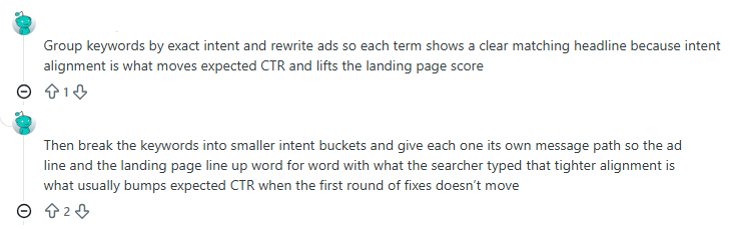
Ad Relevance. Low ad relevance means the ad doesn't align semantically with the keywords it's serving. This typically happens when a single group contains too many different query types — bonuses, reviews, app, sign-up, brand, and competitor terms all mixed together. Practitioners on professional subreddits recommend grouping keywords by precise user intent and rewriting ads so the headline directly answers the specific search query. That means breaking keywords into tight thematic clusters and building separate ad-plus-landing-page combinations for each. When the user sees what they searched for in both the ad and the landing page, rather than one-size-fits-all copy, the entire funnel performs better.
Landing Page Experience. A drop in this metric isn't always about page load speed. The landing page needs to continue the ad's narrative. If the ad mentions a deposit bonus, that bonus and its terms should be visible immediately. If you're targeting Canada, the page should be localized accordingly — language, payment methods, local cues, and so on.
Once those three metrics are in decent shape, move on to negative keywords. There's an important nuance here: regular keywords can be expanded by Google's algorithms to match similar meanings, typos, and close variants — but negatives don't work that way. Adding "casino scam" as a negative won't automatically block "casino fraud," "casino cheat," "casinoo scam," or similar variations. Those need to be collected and added individually.
Affiliates on Reddit recommend not burning money on obviously irrelevant queries just to "wait for data." Some affiliates let non-relevant terms accumulate three to five clicks before cutting them, to avoid disrupting auto-bidding during the learning phase. In expensive verticals, though, that approach can turn into a money leak fast: if a single click costs $15–$20, a handful of clicks on a clearly non-commercial term can burn $75–$100 and give the campaign nothing in return.
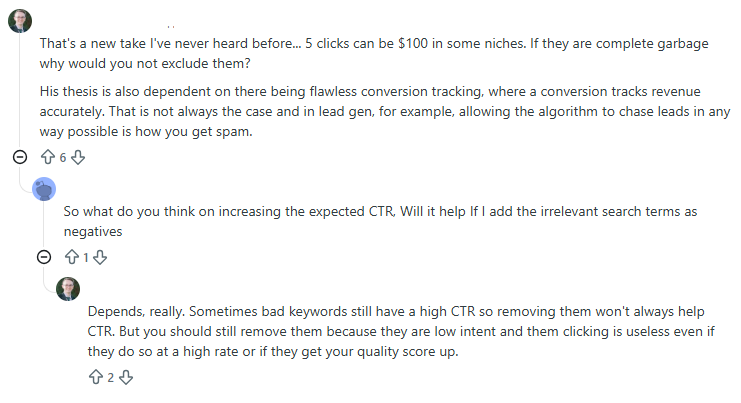
It's also worth noting that high CTR doesn't always mean quality traffic. Some junk queries can click through at solid rates — but if the commercial intent isn't there, those clicks are worthless. The goal isn't to maximize clickthrough at any cost. It's to scrub the campaign of queries that corrupt the learning signal, destroy the economics, and prevent Google from understanding which audience you actually need.
Once the obvious leaks are plugged, the temptation is to flip on an auto-bidding strategy and wait for the numbers to look good. But that's exactly the move that often leads to negative ROI. Experienced affiliate practitioners advise against handing the campaign over to Smart Bidding too early — especially when the account structure is still raw, negative keywords haven't been properly built out, and conversion volume is thin. In that state, Google may aggressively increase bids on certain auctions. CPC bloats, the daily budget burns faster, and click volume drops below expectations.
Affiliates from BlackHatWorld argue it's safer to stay in manual control at the start: watch which keywords are actually driving clicks, identify where CPC is running hot, see which groups are eating budget fast, and spot which queries aren't bringing the right audience. Auto-bidding strategies, in their view, are better introduced after the campaign structure has been cleaned up, ads have been tested, the landing page is in order, and the account has meaningful conversion data to work with.

Working through Quality Score is rarely a straight line. One ad group might show solid expected CTR but generate no conversions. Another might pull good click volume but attract low-quality traffic. The result is a constant process of reallocating budget between hypotheses — trimming spend here, cutting bids there, pausing a campaign somewhere else.
That's why having reliable account infrastructure matters just as much as the campaign work itself. If a budget gets stuck in a banned account, all the optimization goes on hold. YeezyPay addresses this directly: if a rented account gets banned, the service helps find a replacement and returns the remaining balance.
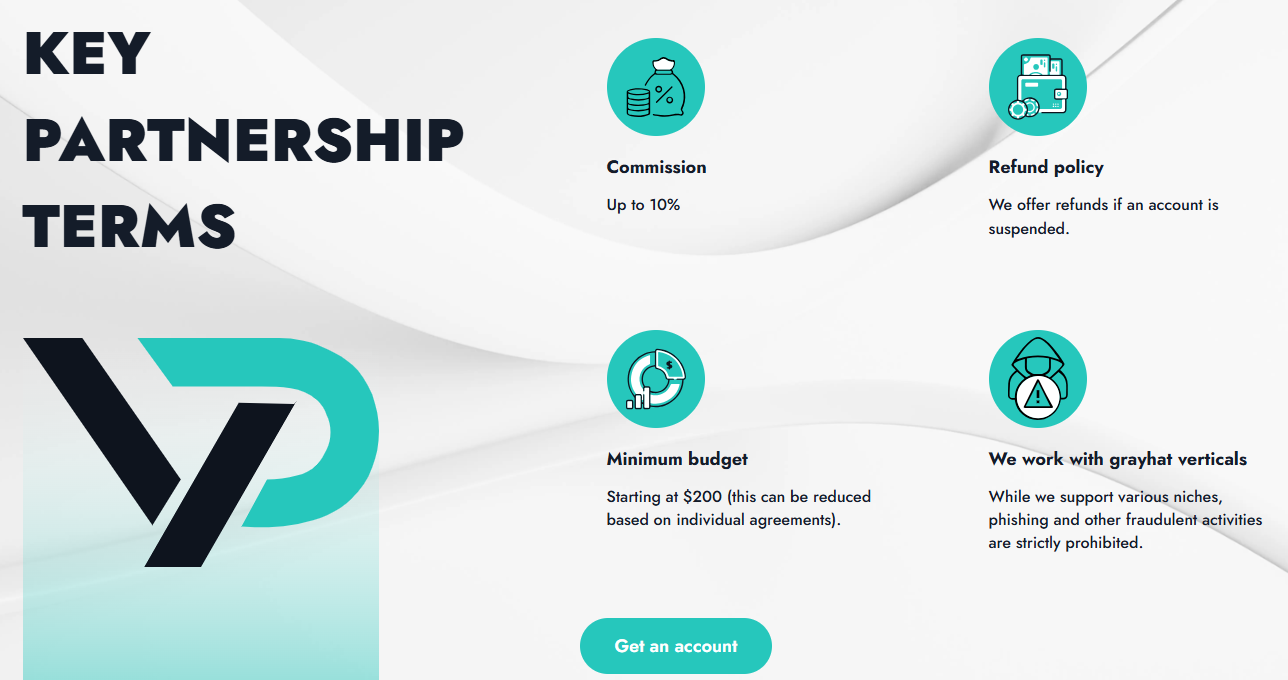
That makes it possible to redirect funds from one account to another quickly, without losing time, money, or momentum.
Final Thoughts
If Quality Score falls below 6–7 points, a CPC increase is nearly guaranteed. When Google Ads is burning budget but delivering few clicks, the solution isn't just adjusting the bid. You need to work through Expected CTR, Ad Relevance, Landing Page Experience, Auction Insights, and bidding strategy. Sometimes the weak link is the ad copy, sometimes it's the landing page — and sometimes the market has simply gotten more expensive because of competitors.
Quality Score improves only through active work on keywords, ads, and the landing page. Keywords need to be segmented by intent. Ads need to be written against specific search queries. The landing page needs to follow through on whatever the ad promised. Don't expect a single bid increase or a blind switch to Smart Bidding to fix things. If the campaign structure is weak, the algorithms will just spend the budget faster on bad signals.
But even once a media buyer has the campaign quality sorted out, there's another question: where to actually run it. Finding a working setup is one thing. Getting an account quickly, topping up the balance, and moving straight to testing — without chasing account sellers, warming up profiles, or constantly hunting for new inventory — is another. YeezyPay covers that side of the workflow too: register, fund your balance, get access to an agency account, and start running campaigns. Verified agency accounts from 10+ MCCs, no lengthy back-and-forth with account managers. The affiliate can focus on finding and scaling a winning setup — not on logistics.


