


Exact Match Is Burning Half Your Budget for No Reason? Here's Why It Happens and What to Do
Exact Match in Google Ads has long been considered the safest match type for anyone who wants confident control over their campaigns. The logic is straightforward: wrap the keyword in square brackets, clean up your negatives, and wait for impressions only on the queries you actually specified. But recently the tech giant quietly reworked how this thing works under the hood.
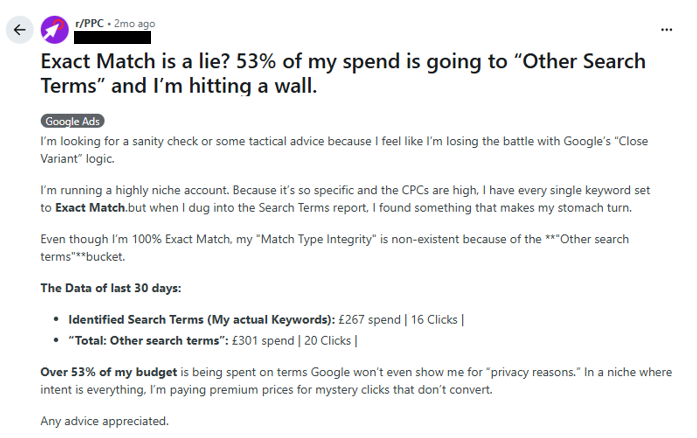
There was a case on Reddit not long ago: a user ran all keywords in Exact Match. Over the last 30 days, the specified search terms ate up £267 and brought in 16 clicks. But close variants that Google doesn't show in the dashboard took another £301 and brought 20 clicks. With a total spend of £568, it's not hard to see that around 53% of the budget went to impressions the affiliate never wanted in the first place.
Today we'll break down what changed in Google Ads and how to adapt so you're not burning money for nothing.
Why Exact Match Isn't Exact Anymore
The main thing to accept: Exact Match no longer means "impressions only for this exact phrase." Before, you could add something like [buy business insurance] and expect your ad to trigger only for that exact phrase or very close variants. But now it's more of a signal to the algorithm than a hard limit. The problem is that over the past few years the platform has been leaning harder into user intent rather than the literal keyword. And from Google's perspective, that makes sense. People search for the same thing in different ways, make typos, change word order, or type incomplete queries. So the algorithm tries to catch the intention, not the exact match.
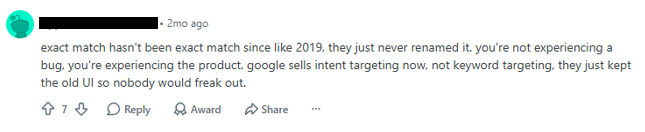
But in any business, similar meaning doesn't always mean similar value. The problem is that one query can carry hot commercial intent, while another is purely informational — someone looking for a promo code, a bonus, or a review. For an affiliate those are different audiences, different conversion rates, and a different cost per click. For Google it's all one thematic bucket.
The Search Terms Report logic adds its own layer to this. According to Google's own developers, the report shows real user queries that triggered ad impressions. But some queries might not appear due to privacy settings when there isn't enough activity behind them. So the buyer thinks they're managing traffic through Exact Match, when in reality they're only managing the input signal. Google itself decides which close variants count as relevant, and a chunk of actual queries gets hidden under "Other search terms."
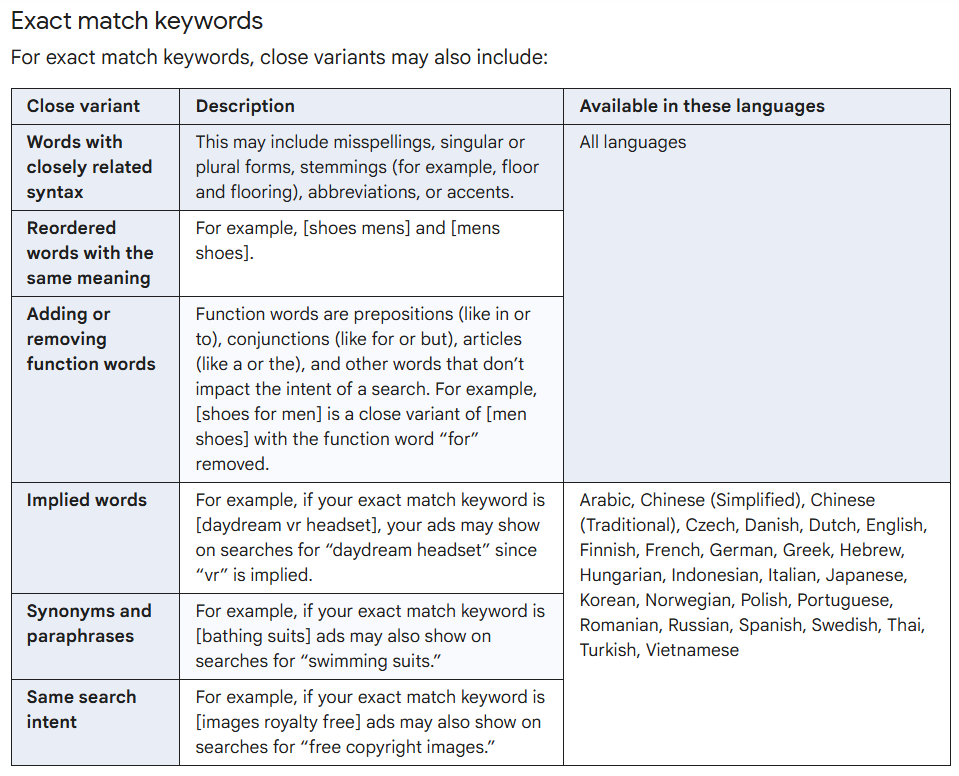
That's exactly why Exact Match today can't be treated as protection against junk traffic. It's a useful match type, but not a self-contained control system. If the campaign structure is weak, negatives are collected superficially, and bidding is handed off to automation without proper data — Exact Match won't save you. It'll just give Google a slightly narrower entry point, and the algorithm will still try to expand from there.
To find the right keywords you'll have to build and launch dozens of campaigns over just a few days. On top of that you'll be constantly updating negative lists, scrubbing search terms, and sometimes rebuilding the whole structure nearly from scratch. On accounts without established trust, that kind of activity quickly turns into a separate risk: the account can get flagged for review or banned before the campaign ever stabilizes. That's why in 2026 experienced affiliates recommend running Google Ads through trusted agency accounts where that level of hands-on optimization looks completely normal to Google. Where do you get those? Simple. YeezyPay gives affiliates ready-made verified agency accounts with history, suitable even for grey-hat verticals.
That way you can adapt quickly to Google's whims without risking your budget or your funnel.
What Definitely Won't Help
The first thing that probably won't work — arguing with support and waiting for a refund. Some Reddit users suggest reaching out to support, adding all visible irrelevant queries to negatives, and filing a complaint about the impression algorithm.
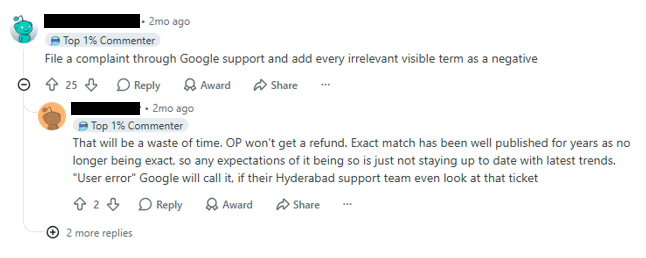
But the issue is that Google officially doesn't treat Exact Match as a literal match. So from the platform's side, the situation doesn't look like a bug — it looks like normal behavior with close variants.
Another mistake is duplicating campaigns hoping Google will start acting more carefully. On the surface the idea makes sense: create a few narrow campaigns, lower the bid in some places, raise it in others, keep only the hottest keywords somewhere. But if the campaigns overlap in keywords, geo, scheduling, and audience, the buyer doesn't get control — they get internal cannibalization.
You also shouldn't expect one negative keyword to block an entire semantic area. Google applies them with a slightly different logic: they don't extend to close variants. If you added "free" to your negatives, it'll only block impressions for exactly that word.

This gives a lot of advertisers the feeling that Google is ignoring their negatives. But after a quick analysis it becomes clear the negative list is just too narrow. For example, if you're running crypto offers on keywords like "get bitcoin" or "open a crypto wallet," one negative for "free" won't cut it. If you don't want informational intent, you'll need to separately add things like:
-
"what is cryptocurrency"
-
"what is bitcoin"
-
"how crypto works"
-
"how to mine"
-
"mining"
-
"trading courses"
-
"crypto book"
-
"crypto forum" and so on.
If you need to cut out the audience that's searching for negative signals or already doubting the offer, "reviews," "scam," "fraud," "complaints," and similar terms go into the negatives too.
Blindly enabling automated strategies won't help either. If the campaign already has junk close variants, overlapping structure, weak negatives, and a big share of "Other search terms," the algorithms will train on irrelevant data. The system will go looking for leads inside the "reality" you gave it — and if half that reality is hidden or irrelevant, the training just burns through your budget.
Counting on Google to eventually refund you for disputed close variant impressions is not a reliable strategy. Better to structure your operation upfront so budget isn't sitting frozen in one account and can be quickly recycled. With personal accounts, refunds are basically off the table, and sketchy agency account providers are more likely to pocket the balance than return it. On this front YeezyPay covers not just access to trusted Google Ads agency accounts but also the financial flexibility side: you can top up via USDT, track spend inside the platform, and get the remaining balance back if an account gets suspended. In the new Exact Match reality that's critical. If part of the budget has already gone into "Other search terms," the rest shouldn't turn into frozen money you can't quickly put toward a new hypothesis.
How to Structure a Campaign So the Budget Goes to the Right Keywords
Unfortunately, there's no way to fully stop Google from expanding Exact Match — close variants apply to all match types and can't be turned off. So the affiliate needs to build their campaigns in a way that gives the algorithms fewer reasons to bleed budget into adjacent demand.
Forum users recommend a solid approach for this situation — split campaigns by intent. Let's say you're promoting Casino N. One campaign gets only branded keywords: "register at Casino N," "deposit at Casino N," "popular slots at Casino N," and so on. Another campaign gets purely generic queries: "create a casino account," "best casinos in Spain," etc. Mix these categories into one campaign and the system gets blurry training signals and starts deciding on its own which queries are semantically close. In practice the AI is not great at this. On top of that, with this kind of split you can quickly figure out which semantic bucket is actually spending in the green.
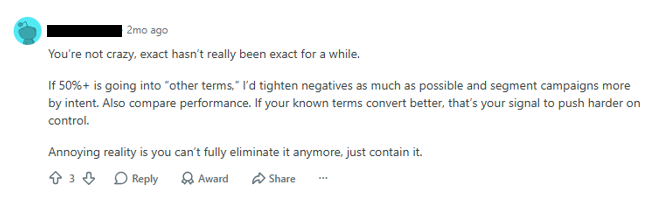
The second solid move is having negative keywords at multiple levels.
At the account level you can keep universal junk that you don't want in any campaign. In betting that might be things like "free," "no deposit," "free tips," and so on.
At the campaign level you negative out intents that interfere with a specific campaign. For example, brand terms go into the negatives of the non-brand campaign, and competitor terms go into the negatives of the brand campaign.
At the ad group level, negatives help separate queries that are close but economically different within the same campaign. For example, one group can be built around hot intent — "online casino registration," "play casino for real money" — while another targets bonus intent: "casino bonus," "sign-up bonus," "free spins," "no deposit bonus."
Cross-negatives are especially useful here — when the keywords from one campaign get added to the negative list of another so Google can't pull impressions between them.
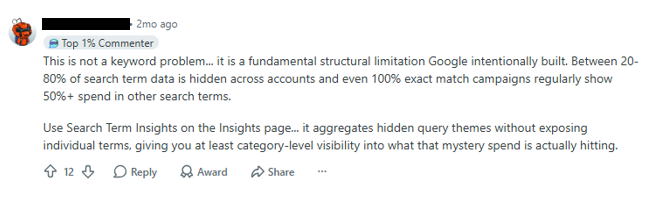
Next, experienced buyers recommend working the Search Terms Report and search term statistics consistently. The Search Terms Report shows which queries users searched before seeing your ad and what happened as a result. That's where you figure out which terms need to go into negatives and which ones deserve their own keywords or ad groups. Pairing this with a proper tracker makes the picture significantly cleaner — especially if you're running across multiple GEOs, where Voluum, RedTrack, or Ringba each handle attribution a bit differently. But some rare queries get excluded from the report due to privacy requirements.
In the search term statistics those terms can end up in subtopics or under "Other search terms" without the actual query text showing. So spend going to "Other search terms" needs its own attention: if it's a small share of the budget it's not critical, but if it's already in the double digits that's a reason to dig deeper.
Don't forget about bids and setting them correctly at campaign launch. While the negative list is still thin and the Search Terms Report hasn't been cleaned up yet, aggressive automated strategies can train themselves on low-quality signals. Manual CPC won't solve the close variant problem, but it gives you more control during the initial test. The advertiser sets their own maximum they're willing to pay per click and can assign separate bids to specific keywords. So at launch you have a clearer picture of where you're limiting your own risk and where you're giving the algorithms more room.
Wrapping Up
In 2026 Google applies close variants to Exact Match, which means the algorithm factors in synonyms, rephrasings, and queries that share the same intent. So if part of the budget is going into "Other search terms," that's not always a bug — it's the result of Google Ads' new logic.
Arguing with support or trying to outsmart the system is not a great idea. To save time, money, and headaches, it's more reliable to split campaigns by intent, not mix branded and non-branded queries, build negatives at the account, campaign, and ad group levels, regularly scrub the Search Terms Report, and keep an eye on the "Other search terms" share. When it gets too high, don't just throw more budget at it — rebuild the structure: cut overlaps, add negatives, lower bids, and pull high-value keywords into their own campaigns.
Without solid infrastructure, constantly tweaking campaign parameters is risky. On a weak account that level of activity can easily end in a review, limits, or a ban with no way to get your money back. That's why for Google Ads it makes sense to start with trusted accounts that can handle ongoing optimization and real spend. You can get those accounts through YeezyPay, which has already issued over 40,000 agency accounts and spent more than $50M through them. All accounts are issued under real agencies that work directly with Google. That lets affiliates test funnels quickly, adapt to new conditions, and not risk their budget any more than necessary.


