


CPC in 2026 Has Shot Up Dramatically — What Buyers Are Saying and What to Do About It
Lately, affiliate forums have been flooded with complaints about Google Ads getting noticeably more expensive. Buyers are reporting that campaigns they had running smoothly for months suddenly saw CPC and conversion costs spike hard in spring 2026 — with zero changes to their settings. One media buyer on Reddit writes that across nearly all of his accounts and in almost every niche he works, click and conversion costs jumped 2–3x between March and May. Maximize Conversions campaigns that had been performing reliably for years started paying more for the same traffic out of nowhere: keywords that used to cost €1–2 per click ballooned to €4–5+.
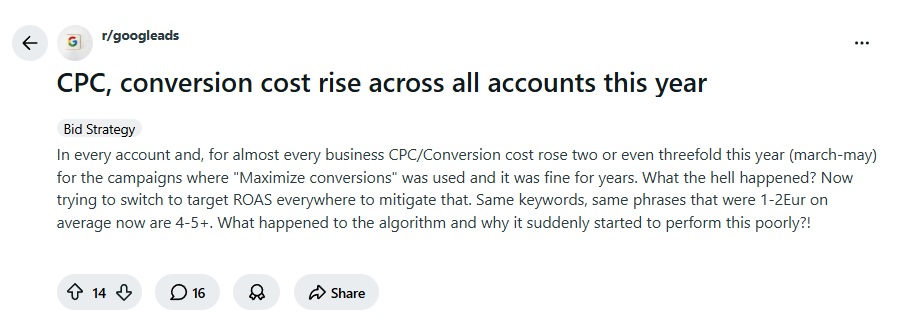
Today we're breaking down why CPC and conversion costs may have spiked like this, which "fixes" will only burn your budget faster, and what buyers can actually do to get back in control.
Why CPC and Conversion Costs Spiked
Google hasn't issued any official statement on this, and it's unlikely they will. What we do have are observations from affiliates who've been running Google Ads for years.
Some think the auction itself has simply gotten more expensive. Several experts link the traffic cost increase to the AI rollout, which brought in a wave of new advertisers looking to launch campaigns. Some point to Google's own reports on AI adoption as one possible explanation. Naturally, when new players enter a niche, veterans raise their bids to hold their positions — and everyone ends up fighting over the same commercial queries, pushing CPC up even when nothing changes inside your account.
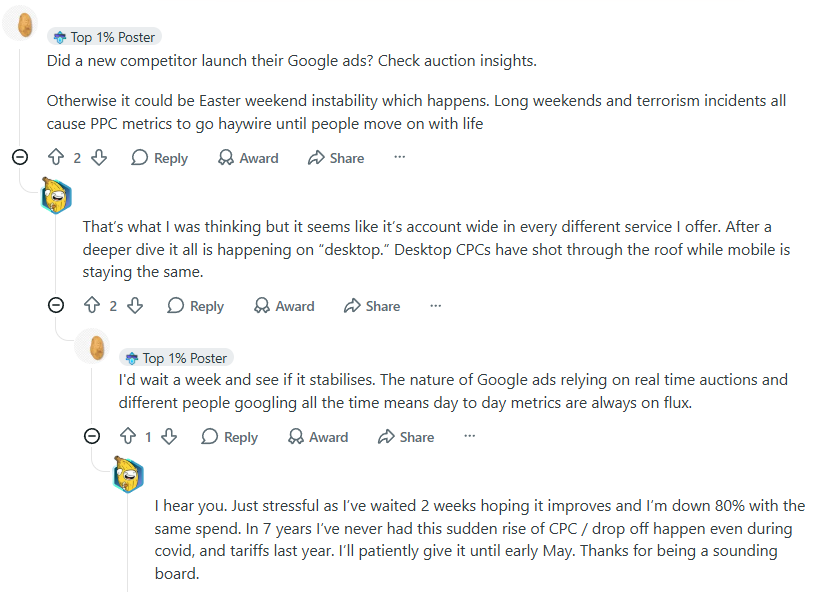
It's important to understand that rising CPC doesn't automatically mean you broke something in your campaign. In one thread about CPC jumping 300%, a community member advises checking Auction Insights first: look for new competitors, see if someone started aggressively buying up impressions, check whether impression share has shifted. Without auditing the auction, you'll start fixing something that actually changed at the market level, not in your account.
Rising CPC doesn't just inflate traffic costs — it raises the price of every test. If $500 used to get you 250 clicks, after a 2x price hike you're getting 125. You now need more time and budget to gather enough data, review your search terms, and determine whether the funnel is still in the black.
At this stage, the ad account itself becomes an additional risk. If the account gets banned mid-test, the campaign stops cold and part of your working capital can end up stranded as an unused balance. The result: you're not just paying for more expensive clicks — part of your working capital may also end up tied up in an inaccessible balance.
That's why when working with pricier traffic, it's worth thinking in advance about what happens to your remaining balance if the account goes down. YeezyPay provides agency accounts from 10+ MCCs, and if an account gets blocked, they help you recover the funds. This way you can quickly put the remaining budget back to work instead of losing it along with the paused test.
Users are also noticing that automated bidding strategies are pulling in more expensive traffic. Take Maximize Conversions — it doesn't promise cheap CPC. This strategy tries to squeeze the maximum number of conversions out of your budget. If the algorithm thinks an expensive click could lead to a conversion, it'll happily bid that price. When the market is cheap, this is barely noticeable — but if major advertisers are already in the niche, a buyer can easily end up paying several times their usual CPC.
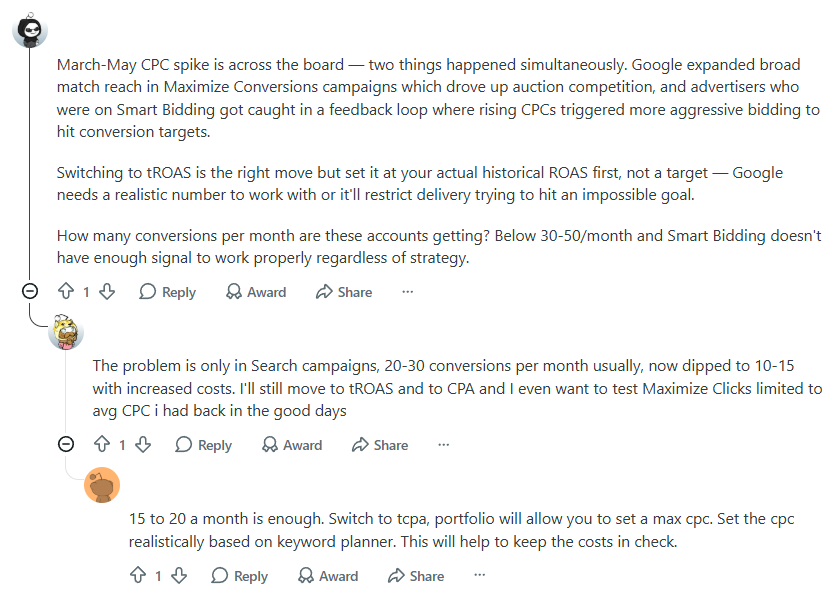
On Reddit, one commenter attributes the 2026 spike to two factors:
-
Google expanded broad match coverage in Maximize Conversions campaigns;
-
Advertisers experimenting with Smart Bidding get trapped in a feedback loop where rising CPC pushes the system to bid even more aggressively in pursuit of conversions.
The same commenter suggests that switching to tROAS can help — but only if you set the target based on real historical ROAS, not a wishful number.
Another factor: AI algorithms are widening the audience pool through Broad Match and Close Variants. It's been clear for a while now that keywords don't behave the way they used to. The system increasingly treats a keyword not as a rigid semantic unit, but reads into the intent behind the query — the landing page, the ads, the conversion history — and looks for similar intents. Sometimes this actually generates additional leads, but more often it pulls in borderline-relevant garbage. A campaign built around a high-intent query like "online casino sign up Brazil" starts surfacing search terms for reviews, promo codes, complaints, apps, and general overviews. Google sees these as adjacent intents; a buyer sees completely different users: one is ready to deposit, one is checking the brand's reputation, and one is hunting for a no-deposit bonus.
The trend is compounded by the rollout of AI Max for Search. Google writes directly that AI Max expands reach into new queries through broad match and learns from existing keywords, creatives, and URLs. For mainstream e-commerce this might be a net positive, but not for affiliates — the wider Google casts its net for "similar" users, the more critical it becomes to scrub your Search Terms and feed the algorithm clean signals.
The last reason that keeps coming up in the community is a degradation in signal quality for the algorithms. If CPC goes up, the same budget delivers fewer clicks. Fewer clicks means fewer conversions. And when conversions are thin, Smart Bidding struggles to understand who it's supposed to be finding. The result is a vicious cycle: clicks get more expensive, data gets thinner, the algorithm learns worse, and bidding becomes even less predictable.
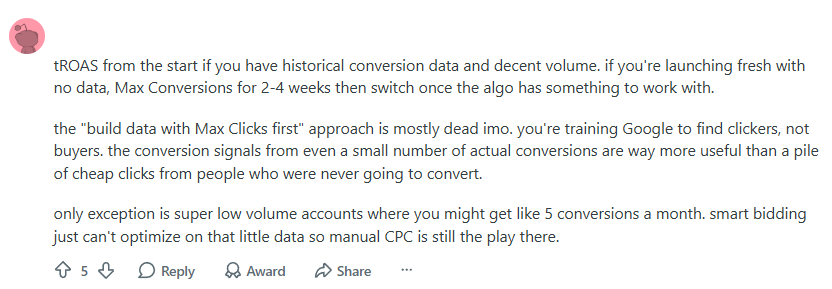
In a recent Reddit thread on Google Search Ads in 2026, one buyer puts it bluntly: if your account has solid historical data and decent volume, go to tROAS. If the campaign is fresh or data-light, give Maximize Conversions 2–4 weeks to accumulate enough material to actually work with.
How to Avoid Digging Yourself Deeper When CPC Is High
When CPC becomes unstable, some buyers instinctively throw more budget at the problem. But if your current campaign settings are already driving expensive clicks, more budget just gives Google more money to repeat the same mistakes: broad targeting, weak search terms, an underoptimized landing page, or junk conversions.
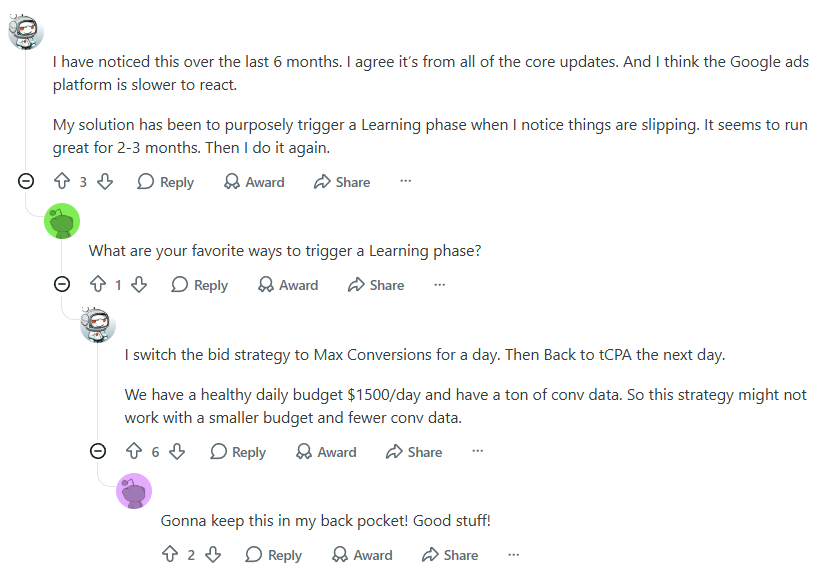
A common mistake is blaming everything on a Google Core Update. In one Reddit thread, a user explicitly points out there's no data that actually proves a connection between Core Updates and rising CPC in paid search. He attributes the drop in performance to higher bids, increased competition, and more advertisers piling onto automated strategies.
You also can't fix CPC with bidding strategy alone. If different intent types are mixed inside a single ad group, Search Terms are full of irrelevant queries, and your landing page doesn't follow through on what the ad promises, any strategy you run is built on a broken foundation. Maximize Conversions, tCPA, tROAS, or manual bidding will just distribute the same budget differently — and none of them will make it profitable.
The most common mistake of all is trying to change everything at once. When CPC jumps 2–3x, inexperienced buyers often try to adjust the budget, bidding strategy, keywords, landing page, negative keywords, and a dozen other campaign elements simultaneously.
The right move is to make changes one at a time. By iterating sequentially, a buyer can identify the actual problem reasonably fast. For example: if your campaign settings haven't changed, traffic quality hasn't dropped, but a serious new competitor showed up in Auction Insights — you're not getting back to your old CPC without raising bids.
In situations like that, testing a neighboring GEO with the same setup can be a smarter play. But dumping a big budget into a fresh account right away is risky — the system can quickly flag or suspend it. However, if you're running on trusted agency accounts from legitimate agencies where spends of tens of thousands of dollars are the norm, the ban risk drops significantly. YeezyPay provides agency accounts from 10+ MCCs for gray niches with no spend limits. The whole system is built around the affiliate's workflow: sign up → top up → get your agency account. This lets you pivot to a new GEO fast without losing momentum.
What to Do When CPC Has Jumped 2–3x
If click costs keep climbing, the first thing to check is Auction Insights. Go into Google Ads, open the campaign, ad group, or keywords, pull up Auction Insights, and look at what changed: did competitors' impression share grow, are they showing up above you more often, did a new player enter the market?
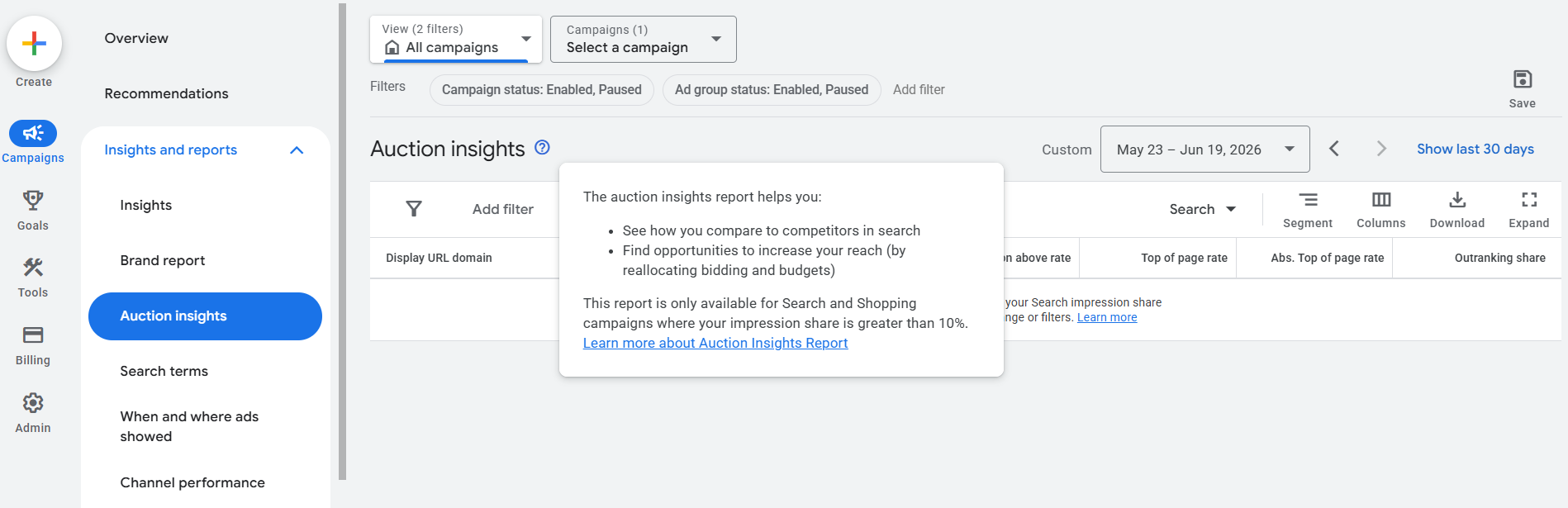
If a well-funded team with a budget you can't match has moved into your GEO, trying to get CPC back to where it was is pointless.
Next, compare time periods. Ideally, the last 2–4 weeks against the previous stable period. Review CPC, CPA, CTR, CVR, Search Impression Share, spend by campaign, and Search Terms. If CPC went up but CTR and conversion rate are holding, the market probably just got more expensive. If CTR and CVR dropped alongside CPC, the algorithms have likely started pulling in less relevant traffic.
After that, audit your Search Terms. Queries that drove conversions should be isolated; borderline-relevant terms go on a watchlist; off-target intents get negated. Pay close attention to reviews, job listings, promo codes, free bonuses, complaints, "how does it work" queries, and similar formulations that can quietly drain your budget.
Then check your bidding strategy. If Maximize Conversions has been pulling in traffic that's too expensive, test tCPA or tROAS — strategies where the algorithm actively targets specific cost-per-action or return-on-ad-spend thresholds. Also review Search Partners to see whether that's where irrelevant traffic is coming from. In a BlackHatWorld thread on Google Ads, several users note that manual bidding isn't dead yet, but Google is pushing automation harder, and junk traffic from Search Partners has become a real issue. One person flatly recommends turning Search Partners off if it's not converting.

Wrapping Up
Rising CPC in Google Ads doesn't always mean you misconfigured something. Click costs can climb because of new competitors, more aggressive automated bidding, expanded audience targeting, or degraded signal quality. That's why the first step is figuring out what actually changed — the auction itself, your search terms, or your traffic quality.
If you do need to make changes, work sequentially: start by comparing periods and checking Auction Insights, then dig into Search Terms, cut non-converting intents, and see how CTR and conversion rate have shifted. Only after that should you touch your bids, swap bidding strategies, or restructure the campaign. Changing everything at once means you'll never know what actually helped and what just cost you more money.
When a team is managing multiple accounts, the problem often isn't the campaigns themselves — it's expense visibility. One account's CPC is climbing, another's ROAS is slipping, and a third keeps spending budget on irrelevant queries. If those accounts come from different providers, the buyer is constantly switching between dashboards and manually stitching together the full picture. By the time they notice the traffic cost increase, it's already eaten a noticeable chunk of spend.
Catching these dips faster is easier with a unified management system. YeezyPay gives you access to agency accounts through a single interface where linked accounts, reporting, and access permissions are all centrally managed. You don't have to piece together your ad infrastructure from multiple sources: get your accounts through one service and compare campaign performance without the mess. This makes it easier to stay on top of operations, monitor CPC, and avoid pouring money into setups that aren't working.


