


How to Pass Google Ads Review for Health Supplement Offers
Supplement ads don't get rejected by one rule. They get rejected by five, and two of them will end your account on the spot.
That's the part almost nobody explains. Advertisers read Google's healthcare policy, clean up their ingredient list, resubmit, and get hit again — because the violation was never in the ingredient list. It was in a before-and-after image, or a testimonial without a disclaimer, or a redirect sitting between the ad and the offer. Each of those lives under a different policy, with a different punishment. One gives you a warning and a week to fix it. Another gives you nothing.
I'm Mike. I review the payment side of Google Ads at YeezyPay, and supplement advertisers are a steady share of the people who come to us after an account goes down. So this piece isn't a list of banned pills. It's a walk through the review machine itself — what it actually looks at, what each state means, and what to do at each one.

Most supplement disapprovals have nothing to do with the product itself.
The five policies that govern supplement ads
Here's the structure. Memorise this table and you'll diagnose your own disapprovals faster than support will.
| Policy | What triggers it | Enforcement |
|---|---|---|
| Healthcare and medicines → Unapproved substances | Banned ingredient, listed product, disease claim on a non-approved product | Warning first (at least 7 days), then strikes |
| Misrepresentation → Unreliable claims | Miracle cures, extreme weight loss, testimonials without a disclaimer | Warning first, then suspension |
| Misrepresentation → Clickbait ads | Before/after imagery, zoomed-in altered body parts | Warning first, then suspension |
| Misrepresentation → Unacceptable business practices | Fake medical authority, scam funnels | Immediate suspension, no warning |
| Abusing the ad network → Circumventing systems | Cloaking, bridge pages, deceptive redirects | Immediate suspension, no warning, no return |
The first three are survivable. You get told, you fix it, you carry on. The last two aren't. Google's wording on circumventing systems is blunt: violations are "considered egregious," accounts are "suspended upon detection and without prior warning," and you "will not be allowed to advertise with Google Ads again." Reinstatement happens only in what they call compelling circumstances.
Ten policies sit on that egregious list. Two of them are reachable by an ordinary supplement funnel. That asymmetry should shape every decision you make.
What Google actually reviews
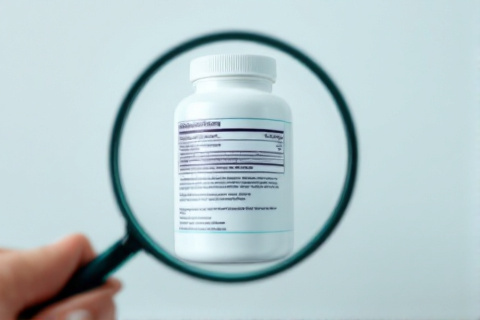
The label and the landing page get read as carefully as the ad copy.
The review covers your headline, your description, your keywords, your destination, and any images or video. Keywords and destination are where supplement advertisers get caught, because they assume review means ad copy.
It doesn't. Your ad can be perfectly clean while the landing page carries a disease claim, or while a keyword pulls in a prescription drug term you're not allowed to target outside the US, Canada and New Zealand. Google reads the whole chain.
Most ads are reviewed within one business day. If a status hasn't moved after two business days, something's stuck; after a week, contact support. Paused ads get reviewed too, which is genuinely useful — build the campaign, pause it, let review clear, then switch it on when you're ready.
One status confuses people constantly. "Eligible (limited)" is not a penalty. For compliant health ads it's the normal resting state. It means your ads are restricted in where and when they show, not that you've done something wrong.
Three tiers of supplement eligibility
Before you write a single line of copy, work out which tier your product sits in.
Tier 1 — prohibited outright. No certification unlocks these. Products containing ephedra. hCG marketed for weight loss or paired with anabolic steroids. Prohormones and anabolics — M-Drol, Halodrol, Superdrol, Turinabol and relatives. DMAA products. Anything on Google's non-exhaustive list of unapproved pharmaceuticals and supplements, which runs to hundreds of named products across weight loss, sexual enhancement and disease-specific "formulas." Herbal and dietary supplements carrying active pharmaceutical or dangerous ingredients. Anything subject to a government or regulatory warning. And anything with a name confusingly similar to an unapproved drug.
Also in Tier 1, and far more commonly tripped: a non-government-approved product marketed in a way that implies it's safe or effective at preventing, curing or treating a disease. That's a claims problem dressed as an ingredient problem. Same product, different sentence, different outcome.
Tier 2 — geo-gated. DHEA runs only in campaigns targeting the United States. Non-pharmaceutical topical CBD needs LegitScript certification first, and even then serves only in California, Colorado and Puerto Rico. Melatonin got liberalised twice and the two changes are easy to confuse: in June 2025 Google Ads dropped the prohibition on promoting melatonin outside the US and Canada, and in November 2025 Merchant Center started allowing legal melatonin supplements in Germany, France and Spain. Those are two different surfaces — Ads and Shopping. Prescription melatonin stays prohibited either way.
Tier 3 — generally eligible. Ordinary over-the-counter supplements, clean ingredients, structure/function claims you can actually substantiate. This is where a sustainable supplement business lives.
My honest opinion, after watching a lot of these accounts: if you're in Tier 1, stop optimising the funnel. There's no funnel that fixes it. The advertisers who last are the ones who changed product, not the ones who changed landing pages.
Country bans most advertisers never hear about

Four countries where supplement promotion is restricted regardless of product.
These sit in Google's Merchant Center healthcare documentation, which is not where a search advertiser thinks to look. They're worth knowing because they override everything else.
- Russia — Google doesn't allow promotion of the online sale of dietary supplements.
- Turkey — Google doesn't allow the promotion of dietary supplements at all.
- Mexico — dietetic products and supplements aren't allowed.
- Spain — weight-loss products are prohibited if they claim medicinal properties, promise specific results, or use endorsements. Weight-loss medical procedures are prohibited outright.
Separately: prescription drug terms can't appear in ads or landing pages outside Canada, New Zealand and the US, and in those three you need certification to keyword-target them. Non-promotional uses are carved out — regulatory warnings, legal notices, public health campaigns, academic publications. Since October 2025 that carve-out extends to ad text and landing pages in those limited contexts.
Claims and landing pages: the exact artefacts you need
This is the section where compliance stops being abstract. Each item below is a thing that either exists on your page or doesn't.
The FDA disclaimer. If you make a structure/function claim, 21 CFR 101.93 requires this wording: "This statement has not been evaluated by the Food and Drug Administration. This product is not intended to diagnose, treat, cure, or prevent any disease." Boldface, typesize no smaller than 1/16 inch. Claims aren't pre-approved — you hold the substantiation yourself and notify FDA within 30 days of marketing.
Testimonial disclaimers. Google's unreliable claims policy requires that any testimonial claiming specific results carries a visible disclaimer stating results aren't guaranteed and vary by person. Visible, not buried in a footer modal.
A refund policy. If you guarantee results, you need a clear and easily accessible money-back policy. No policy page, no guarantee language.
No before-and-after imagery. The clickbait policy specifically prohibits before/after images promoting significant alterations to the human body. Also out: clearly altered zoomed-in body parts. This one catches a lot of otherwise-careful weight-loss advertisers.
Substantiation that meets the FTC bar. The FTC's Health Products Compliance Guidance, issued December 2022 and drawing on 200-plus cases, defines competent and reliable scientific evidence as tests, analysis, research or studies conducted and evaluated objectively by qualified experts, using methods generally accepted in the profession. Most commentators read that as randomised controlled human trials. A customer survey isn't evidence.
If you target the EU, a different regime entirely. Regulation (EC) 1924/2006 requires health claims to be pre-authorised. The Commission's 2012 "on-hold" list covers 2,078 botanical claims EFSA still hasn't evaluated — usable only subject to national provisions, and not every Member State permits them. A page that's compliant in the US is frequently not compliant in Germany.
Then the destination rules, which kill affiliate funnels more than anything else: destination mismatch, destination not crawlable (AdsBot has to be allowed), insufficient original content — the page can't exist primarily to show ads — destination not accessible in the targeted location, and unacceptable URL. A thin review page with three affiliate buttons fails the third test even when every claim on it is true.
The enforcement ladder
Unapproved substances is one of only fifteen policies inside Google's strike system. Clickbait is another. That matters, because the strike system is forgiving by design.
First violation: a warning by email, nothing else. Same policy again within 90 days: strike one, three-day account hold. Again within 90 days: strike two, seven-day hold. Again: strike three, suspension. Three strikes maximum per policy, and you have to remedy the issue and submit an acknowledgement form before serving resumes.
So a supplement advertiser who gets an unapproved-substances warning has real room to correct course. A supplement advertiser who cloaks has none. That's the whole lesson of this article in two sentences.
And to be unambiguous about it: I'm not describing cloaking as a tactic with tradeoffs. It's a one-detection permanent exit, it extends to related accounts, and new accounts created by a suspended advertiser risk automatic suspension. There's no version of this that works out.
Timelines and appeals
Edits to a disapproved ad trigger automatic re-review, typically inside 24 to 48 hours. You don't need to contact anyone.
For a formal appeal, go to Policy manager → Policy issues → Appeal, and pick your route carefully. "Dispute decision" goes to human ad reviewers — use it when you believe the classification is wrong. "Made changes to comply with policy" is system-reviewed — use it when you've actually fixed something. Picking the wrong one wastes a cycle. Appeal history tracks the outcomes.
For account suspensions the appeal window is at least six months. Identity verification allows three attempts. And filing excessive appeals gets your appeal processing suspended for seven days, so volume isn't a strategy.
Why a brand-new compliant account still underperforms
Here's something that blindsided several advertisers we work with. Starting August 2026, Google began expanding its Limited Ad Serving policy across all of Google Ads, rolling out gradually through 2028. Qualification depends on account maturity, advertiser verification status, policy compliance history, user reports, format usage and industry.
Translation: a new supplement account gets impression caps even when every ad is clean. Compliance gets you approved; it doesn't get you trusted. Trust is built from verification status, account age, and an unbroken compliance record — which is exactly what you destroy when you burn accounts and start fresh.
This is where our side of things touches yours. An account only accumulates age and a clean history if the billing behind it stays stable. Declined cards, failed payments and sudden billing-country changes are how otherwise-compliant accounts get flagged, reset, or abandoned.
Running supplement offers from a restricted country?
If local cards don't work for Google Ads, the account instability that follows is a bigger threat to your approvals than any single policy. YeezyPay funds Google Ads through agency accounts with stable billing, so your compliance history has a chance to compound instead of resetting every few months.
A real example from our side
Last quarter an affiliate came to us after three suspensions in five months on a joint-support supplement. The product was fine — Tier 3, clean ingredients, substantiated claims. Every suspension traced to the same thing: a tracking redirect between the ad and the offer page, inserted by the network, that Google read as a bridge page.
They'd been rebuilding accounts and rewriting ad copy for five months. The copy was never the problem. Once they moved to direct linking with a proper landing page and stopped the redirect, approvals held. But they'd already lost three accounts' worth of trust history, which is the part you can't buy back.
The checklist

Each item maps to a named policy, not to general good intentions.
Product level
- Checked against Google's unapproved pharmaceuticals and supplements list
- No ephedra, DMAA, DMHA, higenamine, tianeptine, hCG-for-weight-loss, prohormones
- DHEA campaigns targeting US only
- No regulatory action or warning outstanding against the product
Claims level
- No disease prevention, treatment or cure language anywhere in the chain
- No "as effective as prescription" framing
- FDA structure/function disclaimer present, boldface, correctly sized
- Testimonials carry a visible results-vary disclaimer
- Guarantees backed by an accessible refund policy
- Substantiation on file that meets the FTC evidence standard
Creative level
- Zero before/after imagery
- No altered or zoomed body parts
- Timelines and outcomes plausible, not improbable
Destination level
- Ad destination matches the displayed URL
- AdsBot allowed in robots.txt
- Substantial original content, not an ad shell
- Page loads in every targeted location
- No redirect chain, no cloaking, no geo-switching
Account level
- Advertiser verification completed
- No supplement targeting in Russia, Turkey or Mexico
- Spain weight-loss conditions checked if targeted
- Health excluded from Customer Match, your-data segments, audience expansion and lookalikes — health is a sensitive interest category and personalized advertising there is prohibited
- Billing stable enough that the account survives to accumulate history
The numbers, honestly
Google's 2025 Ads Safety Report gives the real figures. Across all verticals, 8.3 billion-plus ads blocked or removed, 4.8 billion-plus restricted, 24.9 million-plus advertiser accounts suspended, 480 million-plus web pages blocked or restricted. Thirty-five policy updates shipped during the year. Over 99% of violating ads were stopped before serving.
For healthcare and medicines specifically: 87.8 million-plus ads blocked or removed, 119.3 million-plus restricted. Note the shape of that — more ads restricted than removed. The system's default move in health is to limit, not kill.
And one thing I want to say plainly, because the competing articles on this keyword all do the opposite. There is no published supplement-specific disapproval rate. Google doesn't release per-vertical rejection percentages, and no agency dataset I've seen supports one. If you read "72% of supplement ads get rejected" somewhere, that number was invented. Same goes for most of the affiliate market-size figures floating around — they come from aggregator blogs citing each other.
The supplement market itself is large and the estimates vary widely: roughly $196 billion (Grand View Research) to $218 billion (Research Nester) globally for 2025, growing somewhere between 7.5% and 9.5% annually. Take the range, not any single number.
What I'd actually do
Three things, in order.
Establish your tier before you spend a cent on creative. If the product is Tier 1, change the product. No amount of clever copy survives an ingredient-level prohibition, and the attempts to make it survive are exactly what pushes advertisers toward cloaking and permanent bans.
Then audit the destination, not the ad. Disapprovals cluster there — redirects, thin content, missing disclaimers, geo-inaccessible pages. The ad is the part you look at most and the part that's wrong least.
And treat the account itself as the asset. Policy compliance is now an input to how much your ads serve at all, through Limited Ad Serving. An account with two years of clean history and verified billing is worth more than any individual campaign you'd risk it on.
Supplements are a restricted category, not a forbidden one. Plenty of advertisers run them profitably for years. They just do it in Tier 3, with the disclaimers actually on the page, and without anything sitting between the click and the offer.
Policy facts verified against Google Ads, Merchant Center, FDA, FTC and EU primary sources as of October 2026. Google shipped 35 policy updates in 2025 and has dated changes queued through 2028 — re-check the official pages before acting on anything time-sensitive here.


