


Google Ads in Belarus 2026: Bank Transfer Ban and New Rules
Here's the line that changed everything for Belarusian advertisers. On its own billing help page, Google wrote that it would "no longer accept bank transfers from bank accounts based in Belarus," and that monthly invoicing for those accounts would be suspended from January 24, 2025.
That's it. One sentence, and a whole payment method vanished.
I'm Mike, and I work with advertisers at YeezyPay. We help people in restricted countries keep their Google Ads running through agency accounts, so Belarus crosses my desk almost every week. The questions I get are always the same. Is Google Ads banned in Belarus? Why does my card keep failing? Is there a legal way to pay? Let's sort the facts from the panic, because most of what's written about this is half right at best.
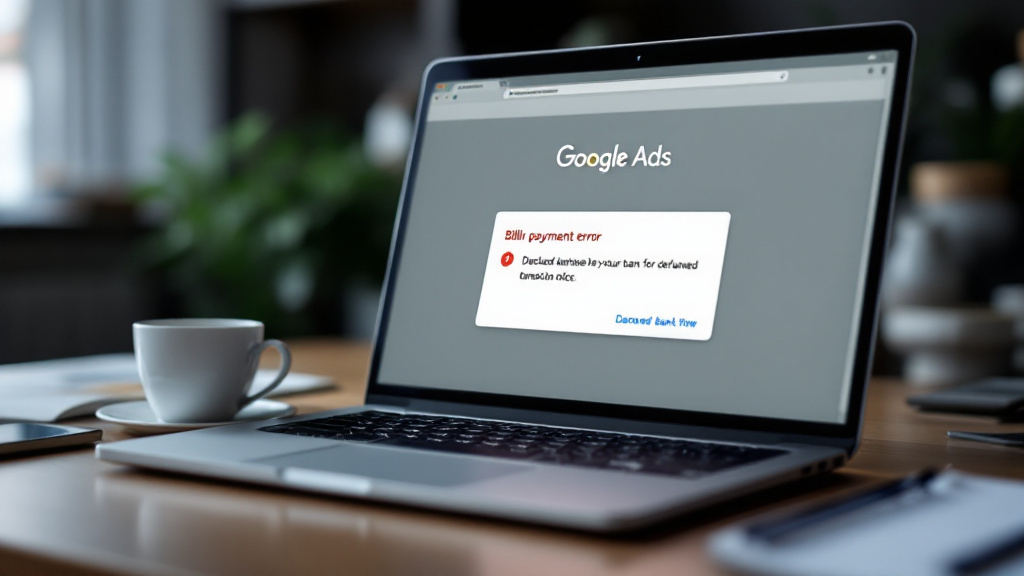
The error Belarusian advertisers started seeing in early 2025.
Belarus isn't embargoed — but the payments are
First, the myth that needs to die. Belarus is not on Google's hard embargo list.
Google's official country restrictions page names only six places where Ads legally can't operate: Crimea, Cuba, the so-called DNR and LNR regions, Iran, and North Korea. Belarus isn't there. So when someone tells you Google Ads is "banned" in Belarus the way it's banned in Iran, they're wrong. The platform works. You can build campaigns, you can target, you can run.
The problem is narrower and more annoying than a full ban. Belarus is restricted, not embargoed. Ads functions, but the money rails that used to feed it have been pulled out one by one. Bank transfers are gone. Cards are shaky. And there's no local Google office to call when something breaks.
I'll be honest about why this distinction matters so much. If Belarus were truly embargoed, there'd be nothing to discuss and no legal route forward. Because it isn't, a compliant payment path still exists. That gap between "restricted" and "embargoed" is the entire reason advertisers in Minsk can still run ads in 2026.
What actually broke: the sanctions chain

Cards from sanctioned issuers often decline even with 3-D Secure.
The bank transfer ban didn't appear out of nowhere. It sits on top of years of sanctions, and the chain is worth understanding because it tells you which workarounds survive and which don't.
Start with SWIFT. Back in 2022, the EU cut several Belarusian banks off the SWIFT network — Belagroprombank, Bank Dabrabyt, and the Development Bank among the first, with Belinvestbank added later that year. That alone made wire transfers to foreign companies painful.
Then it got heavier. In July 2025, the EU upgraded those SWIFT cuts into a full transaction ban on the named banks and the entities they majority-own. In October 2025 the list grew again, adding BelVEB, Belgazprombank, and the Belarusian arms of Alfa-Bank, Sber, and VTB. That brought the count to nine Belarusian banks under a total EU transaction ban. Visa and Mastercard restricted card operations for the sanctioned issuers on top of that.
Now here's the twist most articles miss. The US has been moving the other way. Since September 2025, Washington has eased Belarus sanctions in stages tied to prisoner releases — a general license for Belavia, and a March 2026 package that delisted potash entities and authorized certain transactions with Belinvestbank. The EU did not follow. So you've got Europe tightening while America loosens.
Why does that matter for your ad account? Because Google is a US company, and it answers to OFAC, not Brussels. OFAC easing on Belarus is a big part of why Belarus stays off Google's embargo list even as the EU piles on. The ads keep running; it's the European banking rails that keep snapping.
What about cards? The honest answer
This is where I have to manage expectations.
Technically, Google accepts Visa and Mastercard debit and credit cards from Belarus. In practice, it's a coin flip. Cards from sanctioned issuers get blocked at the BIN level, sometimes even when 3-D Secure passes cleanly. Advertisers describe the classic pattern: a card works on Monday, funds a campaign fine, then declines on Thursday with no explanation.
Two card types never work for international Google billing at all:
- Belkart — the Belarusian domestic card system, with no international acceptance.
- Mir — same story, a closed-loop system Google won't touch.
And prepaid cards? Google stopped accepting those for automatic payments a while back, so the prepaid trick people used to lean on is dead too.
My opinion, after watching hundreds of these accounts: don't build a business on a Belarusian card. Even when it works, you're one BIN update away from a frozen campaign mid-flight. That's not a payment method, that's a gamble.
Tired of declined cards and dead bank transfers?
YeezyPay runs your Google Ads through a compliant agency account — no Belarusian bank needed, setup in about 15 minutes.
Get started with YeezyPayCurrency, VAT, and the missing Google office
Even when you do get a payment through, two more surprises wait.
Belarusian Google Ads accounts bill in US dollars, not Belarusian rubles. That sounds minor until you're reconciling spend against a BYN bank statement and watching the exchange rate eat your margin. On top of that, advertisers carry a 20% VAT obligation on the spend, and there's no Google representative in Belarus to hand you clean closing documents for your accountant.
That last point causes real headaches. Local intermediaries built a small business just around this — services that settle in BYN with a fixed commission and, crucially, hand you the paperwork your bookkeeper needs. It tells you how broken the direct route is when a side industry exists purely to generate invoices Google won't give you.
The three workarounds, compared honestly

An agency account moves billing to a compliant foreign entity.
There are three realistic paths out of the Belarus payment trap. None is perfect. Here's how they stack up.
The first is an agency or MCC account, where a compliant agency abroad adds you as a managed client and handles billing. No Belarusian card, no SWIFT, no foreign company of your own. It's the lowest-risk route and the fastest to set up. The trade-off is a commission and some dependency on the provider.
The second is your own foreign legal entity with a foreign business card. Full control, fully legitimate, but slow and expensive. You'll file a W-8BEN-E, open real business banking abroad, and make sure every name matches across your payments profile and verification documents. Best for big spenders playing the long game.
The third is a payment intermediary that routes your spend for you. Fast, often crypto- or local-currency friendly, no incorporation needed. The catch is that the provider's compliance track record is everything — pick a serious one or don't bother.
| Approach | Risk | Setup speed | Best for |
|---|---|---|---|
| Agency / MCC account | Low | Fast (~15 min) | Most advertisers |
| Own foreign entity | Low | Slow (weeks) | Large, long-term spenders |
| Payment intermediary | Medium | Fast | Affiliates, flexible budgets |
| VPN + borrowed card | High | Instant | Nobody — this gets you banned |
That last row isn't a real option. I list it because people still try it, and I keep watching those accounts get suspended. A mismatched billing country and a borrowed card is the fastest way to lose everything you've built.
How we handle Belarus at YeezyPay

Let me give you a concrete example from our own desk, because abstract advice only goes so far.
A media buyer from Minsk came to us last quarter after three cards declined in a single week. His campaigns were profitable — the only thing failing was the payment. We moved his billing onto one of our agency accounts. He topped up in a currency that actually clears, we covered the Google side through a compliant foreign entity, and his ads were live again the same afternoon. No SWIFT, no Belkart, no BIN roulette.
What made it work wasn't a trick. It was that the agency account sits on payment rails Google still trusts, in a jurisdiction that isn't tangled in the EU transaction ban. The advertiser stays in Belarus; the billing doesn't have to.
I want to be precise about the legal framing here, because it matters. Belarus is not OFAC-embargoed for Google Ads. Routing a legitimate Belarusian advertiser's spend through a non-sanctioned agency account is a different thing entirely from sanctions evasion — and we won't touch anything that crosses that line. Compliance isn't a marketing word for us; it's the reason our accounts don't disappear.
One thing that got easier in 2026
Not all the 2026 news is bad. As of January 22, 2026, Google began allowing gambling ads in Belarus for operators licensed by the Ministry of Taxes and Duties, with lotteries handled under separate authorities.
That's a content-eligibility change, not a payment one — it doesn't fix your billing. But it's a signal worth reading. Google is fine-tuning what runs in Belarus rather than walking away from the market. For advertisers, that's a reason to solve the payment side properly instead of giving up on the country.
Quick answers to the questions I hear most
Is Google Ads banned in Belarus? No. Ads works. Bank transfers from Belarusian accounts are what's blocked, since January 24, 2025.
Can I just use my Visa from a Belarusian bank? Sometimes, briefly. Cards from sanctioned issuers decline often, and Belkart and Mir never work internationally. It's not reliable enough to scale on.
Did AdSense get shut down too? Yes, but that's the publisher side — earning money, not spending it. Google deactivated Belarus AdSense, AdMob, and Ad Manager accounts around late 2024. Don't confuse that with your advertiser account; they're separate systems.
What's the safest way to keep advertising? An agency account. It keeps you compliant, needs no local bank, and gets you running in minutes instead of weeks.
The bottom line
Belarus is a restricted market, not a closed one. The bank transfer ban and the wobbly cards are real, and they're not getting better while the EU keeps tightening. But Ads still runs, and there's a clean, compliant way to pay for it.
If you're burning hours on declined cards and dead wires, that's time you could spend on campaigns instead. We built YeezyPay for exactly this — Belarusian advertisers who just want their ads to stay live without breaking any rules. Come talk to us and we'll get you sorted.


