


Cheapest Google Ads Agency Accounts 2026: Pricing and Fees
Every week someone asks me the same question: who sells the cheapest Google Ads agency account?
I've stopped answering it directly. Not because it's a bad question, but because the headline percentage almost never matches what leaves your wallet. I pulled the published rate cards of roughly twenty providers in October 2026 and ran the arithmetic at four spend levels. The provider with the lowest advertised commission was the most expensive option at $3,000 a month. The one that looked mid-priced came out cheapest below $10k. Nobody's pricing page tells you that.
So this piece does something slightly different. Instead of ranking providers by the number on their homepage, I'll show you where the money actually hides, give you the real published figures with sources, and hand you the formula to run the comparison yourself. I'm Mike, I work at YeezyPay, and yes, we're one of the providers in the table. I'll tell you plainly where we're not the cheap option.
The published rate cards, October 2026
Here's what providers actually print on their own sites. I've separated provider-published numbers from third-party listings, because the difference matters a lot.
| Provider | Commission | Minimum deposit | Other fixed costs | Source quality |
|---|---|---|---|---|
| GDT Agency / SpeedX | 0.5% | $200–500 | — | Third-party listing |
| AdsInfra | 2.5% flat | Not published | None disclosed | Provider-published |
| Threasury | 3.0% sliding to 1.5% | $200 top-up, $1,000/mo minimum budget | Optional 0%-fee plans at $899–$2,499/mo | Provider-published |
| Ecomparkour | 3% | $300 first, $200 after | $249 one-time, non-refundable | Provider-published |
| Let's Ads | 4–8% | $300 | $10 per account opened | Third-party listing |
| Adwin | 4–9% | $500 | — | Third-party listing |
| Uproas | 0–4% by plan | $200 | $299–$995/mo subscription | Third-party review |
| Zenattica | 1–6% | — | $149.99/mo | Third-party listing |
| AdGuardians | 0% | — | $399/mo subscription | Third-party listing |
| CapitalMediaHub | 5–10% per payment | Not published | Crypto/PayPal network fees non-refundable | Provider-published |
| YeezyPay | 5–10% by volume | $200, reducible | No monthly fee | Provider-published |
| KAIF Agency | 5–10% | $500 | — | Third-party listing |
| ROI-CRAFT | 7% | $500 | — | Third-party listing |
| This is Fine | 4–8% | $1,000 | — | Third-party listing |
| Zmatic | Tiered, % not published | $200 | Bills at tier minimum if you underspend | Provider-published |
Two things jump out of that table.
First, only about a third of these companies publish a number at all. AdSkill, one of the better-known names, has no pricing anywhere on its own site — the 2–10% and 5–10% figures floating around come entirely from competitor listicles. We checked. Same story for 4x4.agency, Mediabuy and Adsbalance: we couldn't find a single primary-source price for any of them, so they're not in the table. If a comparison article quotes you a precise percentage for those providers, ask where it came from.
Second, the three cheapest headline rates all carry a catch in the next column.

Headline commission is one line on the invoice. It's rarely the biggest one.
Where the money actually hides
After going through all of these rate cards, the hidden costs sort into four buckets. Every single provider uses at least one.
1. One-time entry fees
Ecomparkour's 3% is genuinely one of the lowest Google rates published anywhere. It also costs $249 to walk in the door, non-refundable, before you've spent a dollar on ads. Spend $3,000 in your first month and your effective rate that month is around 11.3%. Spend $3,000 a month for a year and it settles back to roughly 3.7%.
That's not a scam. It's a pricing model that rewards commitment and punishes testing. If you're validating three offers before you know which one works, an entry fee is the worst possible shape for your money.
2. Subscriptions dressed up as "0% commission"
AdGuardians advertises 0% on deposits. The real price is $399 a month. Zenattica runs $149.99/mo. Uproas has three tiers from $299 to $995 monthly, with commission dropping as the subscription climbs. Threasury's all-platform "Black" plan is $2,499/mo for zero fees.
None of these are dishonest. They're just conditional. A $399 monthly subscription replacing an 8% commission breaks even at roughly $5,000 of monthly spend. Below that, you're paying for a discount you never collect. Above $20,000, it's a bargain.
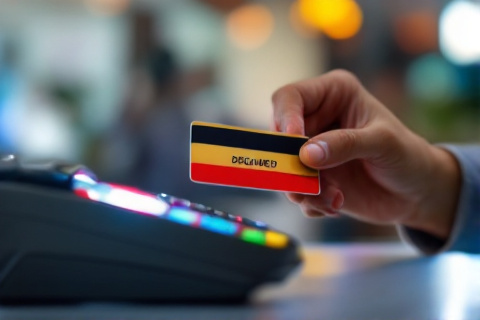
A cheap commission is worthless if the top-up never clears.
3. Tier minimums billed whether you spend or not
Zmatic is admirably upfront about this: commission is charged on actual spend, but if you fall below your tier's minimum, you're billed at the tier minimum anyway. Threasury requires a $1,000 monthly budget to keep the account.
If your spend is lumpy — and in affiliate buying it always is — tier minimums quietly invert the whole ranking. A quiet month on a cheap tiered provider can cost more than a busy month on a flat 8%.
4. Ban-event economics
This is the one almost nobody prices into their comparison, and it's the biggest number in the whole exercise.
Google suspended 24.9 million advertiser accounts in 2025, according to its own Ads Safety Report — down about 36% from 39.2 million in 2024, but still not a tail risk by any definition. When an account goes, the question is what happens to the balance sitting in it. Some providers migrate it to a replacement account for free. Some refund in full within a business day. Some keep a slice.
A 3% provider that keeps 30% of a dead account's balance is, in expectation, far more expensive than an 8% provider that moves your money for nothing. Ask about this before you ask about commission. Get the answer in writing.
My honest opinion on "cheapest"
I'll say the uncomfortable thing: YeezyPay is not the cheapest agency account on the market, and we shouldn't pretend otherwise. Our commission runs 5–10% depending on volume. AdsInfra publishes 2.5% flat. Threasury slides down to 1.5% above $200k a month. On headline rate, they win.
What those rates come with is a different customer. Low-percentage providers tend to carry $1,000/mo budget floors, lean heavily whitehat, and have thin payment coverage for the countries where cards don't work. That's a coherent business — it's just not the same business.
Here's the second opinion, and I hold it strongly: in this market, price is the third most important variable. Ban rate is first, replacement speed is second. A 2.5% account that dies in week two and strands your balance costs more than a 9% account that runs for eight months. Almost everyone buying for the first time gets this backwards, and almost everyone buying for the second time has learned it the expensive way.
What the market range actually is
Agency account rental in 2026 clusters between 2% and 10%. The cheap end is 0.5–3%, typical is 4–8%, and high-risk verticals push 10–20%. That holds across the three most numerically detailed industry tables I could find, all of which are, worth noting, published by companies selling in the same market.
There's a sourcing trap here you should know about. Search "Google Ads agency pricing 2026" and roughly four out of five results are about managed service agencies — the people who build and run your campaigns. That's 10–20% of spend, or $1,500–$10,000 monthly retainers, plus $500–$3,500 setup. Completely different product. If a figure in the 15% range shows up in an agency-account comparison, someone mixed the two and inflated the range by three to five times.

The formula
Run this before you sign anything. It takes two minutes.
Effective rate = (commission × monthly spend + monthly fee + one-time fee ÷ months) ÷ monthly spend
Then add the expected ban cost: probability of a ban in the period, times the clawback percentage, times your typical balance. If a provider won't tell you the clawback percentage, assume it's bad.
Worked at $3,000/mo over six months:
| Provider | Headline | Effective rate at $3k/mo, 6 months |
|---|---|---|
| Ecomparkour | 3% | 4.4% (3% + $249 amortised) |
| AdsInfra | 2.5% | 2.5% |
| AdGuardians | 0% | 13.3% ($399/mo) |
| Uproas Gold | 0–4% | 10.0–14.0% ($299/mo + commission) |
| Mid-% provider | 5–10% | 5–10% |
At $3,000 a month, the 0% provider is the most expensive on the list by a factor of five. At $50,000 a month, that same provider charges an effective 0.8% and wins outright. Same rate card, opposite answer. This is why "who's cheapest" has no general answer — only an answer at your spend level.
The tax layer nobody includes in the price
This is where the real money sits, and it's also where most provider marketing gets sloppy.
Google adds jurisdiction surcharges on top of your spend, based on where the impressions are served, not where you're billed. From Google's own documentation, current rates: Austria 5%, UK 2%, Spain 3%, France 2%, Italy 2.5%, Turkey 4.5%. France and Italy both move to 3% on 1 January 2027; Turkey drops to 2.5% the same day. Canada's 2.5% charge was removed on 1 July 2025 after the country repealed its digital services tax.
Then there's local tax. Turkey is the worst case I found with a clean worked example: 20% VAT by reverse charge, plus 15% withholding on a grossed-up base, plus the 4.5% surcharge. Push 100 units of media through and 147.53 units leave your account. Argentina stacks a 21% VAT perception plus roughly 3% in provincial gross revenue perceptions, and a card-in-USD scenario has been documented around a 54% total uplift. Vietnam's VAT on foreign digital suppliers went from 5% to 10% on 1 July 2025, and the expense stays non-deductible until the tax is declared and paid.
Now the honest part. You'll read that agency accounts "remove VAT entirely." The only sources making that claim are companies selling agency accounts, and Google's documentation contradicts it for the surcharges specifically — those follow the impressions, so no billing arrangement avoids them. What an agency account genuinely does is move the VAT incidence, because the agency's entity is Google's customer rather than you. That's a real saving if you're not VAT-registered or can't recover input tax. If you're a registered business reclaiming VAT anyway, the saving is much smaller than the marketing suggests. None of this is tax advice — talk to someone who files your returns.

The breakeven moves with your spend. Run the numbers at your level, not the provider's example.
What the payment rails cost you
Google charges nothing for currency conversion. It uses a daily bank exchange-rate feed and takes no markup of its own. That surprises people.
The FX cost comes from your bank. Foreign transaction fees typically run 1–3% — about 1% network plus 1.5–2% issuer markup — and exchange-rate markups add another 1–4% on top. That's 2–7% of your budget gone before an impression is served, and it's invisible because it never appears on a Google invoice.
In the countries this blog is mostly about, the problem isn't fees. It's that payment doesn't happen at all. Google suspended all ad sales in Russia in March 2022. Visa and Mastercard suspended Russian operations on 10 March 2022, which ended card payments to Google from Russian-issued cards entirely. A 0.5% commission is a meaningless number if there's no rail to deliver the money.
One thing I won't give you: a card decline rate. We looked specifically for a credible aggregate statistic for Google Ads payment declines and there isn't one. Any article quoting you a precise percentage made it up or copied someone who did.
A concrete example from our side
A media buyer came to us last quarter running about $4,000 a month, having just left a subscription-model provider. He was paying $399 monthly for 0% commission — an effective 10% at his volume — and had picked it specifically because "0%" read as cheapest. He'd been on it five months. That's roughly $2,000 for a discount structure that only starts paying above $5,000 of monthly spend, which he'd never reached.
We moved him to pay-as-you-go. At his volume the commission ran a bit over 8%, so the saving was real but modest — a couple of hundred dollars a month. The bigger change was that when he paused for three weeks to rework a landing page, he paid nothing. Under the old plan, that pause cost $399.
Our own numbers, for the record: 5–10% commission depending on volume, $200 minimum deposit and reducible, no monthly fee. USDT on TRC-20 and ERC-20 plus BTC go in with no deposit fee; we also take VISA, Mastercard and MIR. We're mid-market on price. We don't claim otherwise.
Who's cheapest for you
| Your situation | What usually wins | Why |
|---|---|---|
| Testing, under $3k/mo | Pay-as-you-go %, low minimum, no entry fee | Fixed costs dominate at low volume |
| Lumpy spend, pausing often | Pay-as-you-go %, no tier minimum | You pay zero in quiet months |
| Steady $5k–$20k/mo whitehat | Low-% flat providers (2.5–3%) | Commission is the only real cost |
| $30k+/mo, stable | Subscription / 0%-fee plans | Marginal cost of extra spend is zero |
| Restricted country, cards failing | Crypto-capable mid-% provider | Rail availability beats rate |
| High-risk vertical | Whoever publishes a clawback policy | Ban economics outweigh commission |
Five questions that reveal the real price
- Is there a one-time or setup fee, and is it refundable? Divide it by the months you actually expect to run.
- Is there a monthly minimum spend, and what happens if I fall below it? "Billed at tier minimum" is the answer to listen for.
- What percentage do you keep if the account is banned with a balance in it? The most expensive number in the contract, usually unpublished.
- What are the deposit fees per method? Crypto network fees and card markups are often non-refundable and often unmentioned.
- Can I see this in writing before I deposit? If pricing is "contact us" and stays "contact us" after you contact them, that's your answer.
Want the comparison run on your actual numbers? Tell us your monthly spend, your country and your vertical, and we'll show you the effective rate — including the cases where someone else comes out cheaper. Start at yeezypay.io.
The short version
There is no cheapest provider. There's a cheapest provider at your spend level, in your country, in your vertical, with your tolerance for a dead account.
The published range is 2–10%, the cheap end is real but comes with budget floors and whitehat-only policies, and the "0% commission" options are the most expensive thing on the market below $5,000 a month. Entry fees, tier minimums and ban clawbacks move the ranking more than commission does. Run the formula, ask the five questions, and treat any provider who won't print a number as a provider whose number you won't like.
One more thing, since we're being blunt about pricing. While putting this together I noticed our own commission figure isn't stated identically everywhere it appears online, including in one older post on this blog. The number above — 5–10% by volume, $200 reducible minimum — is the current one, and we're fixing the rest. Holding competitors to a transparency standard we don't meet ourselves would be a bad look, and fair enough.


